Eka Robotics Valued at $1.45B for Force-Sensing AI
The 30-Second Skim
- What happened: Eka Robotics, founded by an MIT professor and a former Google DeepMind researcher, raised $150M at a $1.45B valuation for a force-sensitive robotic manipulation system that veterans say shows 'creepy humanness' in adapting to unfamiliar objects.
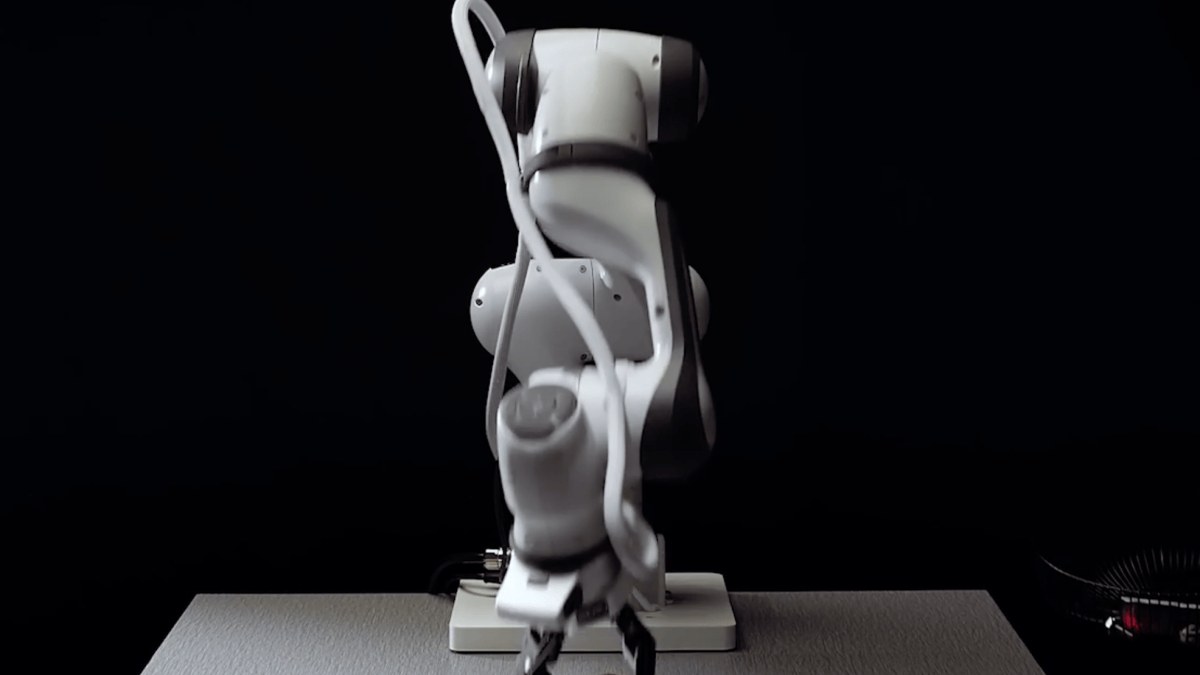
- Key facts & numbers: Eka Robotics closed a $150M Series A at a $1.45B post-money valuation, led by a16z and F-Prime. Eka's robot runs a 'vision-force-action' model rather than a vision-language-action model, relying on touch and force to close the 'last millimeter' of grasping — it picks up roughly 1,500 objects weighing up to 1 kg per hour with 95%+ success, versus about 600 for a human. Eka built a custom force-sensitive gripper priced under $1,000 and rated for 5 million duty cycles, with co-founder Pulkit Agrawal targeting the 20 million cycle bar set by standard industrial arms.
- What happens next: The 'creepy humanness' quote is great, but buried in the article: the bigger test is whether that arm runs a full year on an assembly line without breaking. Eka hasn't proven that yet.
- Eka Robotics closed a $150M Series A at a $1.45B post-money valuation, led by a16z and F-Prime.
- Eka's robot runs a 'vision-force-action' model rather than a vision-language-action model, relying on touch and force to close the 'last millimeter' of grasping — it picks up roughly 1,500 objects weighing up to 1 kg per hour with 95%+ success, versus about 600 for a human.
- Eka built a custom force-sensitive gripper priced under $1,000 and rated for 5 million duty cycles, with co-founder Pulkit Agrawal targeting the 20 million cycle bar set by standard industrial arms.
- Co-founders Pulkit Agrawal (MIT professor) and Tuomas Haarnoja (ex-Google DeepMind) use physics simulation and reinforcement learning to generate thousands of hours of robot experience in minutes, sidestepping the human-demonstration-video pipelines that dominate the field.
Why It Matters
Eka's $1.45B valuation on a $150M round is a public bet that force-sensing — not just vision-language models — is the missing piece for general-purpose robots. If the lab-to-line transition holds, pick-and-place and wire handling become Eka's beachhead into industrial automation; if not, a16z and F-Prime are pricing demos that haven't yet survived a year of factory duty cycles.
Sources Cited
Related Coverage
Ask SkimNews