Inside OpenAI’s agentic software factory
The 30-Second Skim
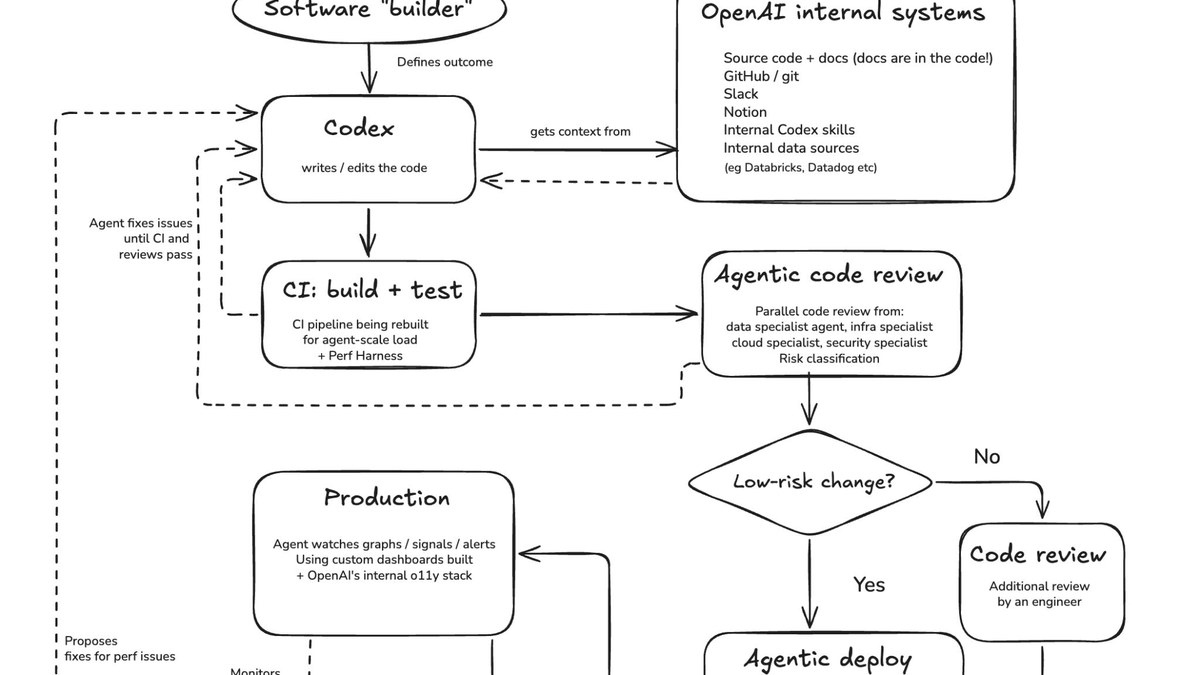
- What happened: At OpenAI, where every employee has an unlimited token budget, Codex adoption among non-engineering teams has surged from near-zero to 90% in roughly four months, transforming the lab into an "agentic software factory" where AI agents and automated feedback loops now drive nearly all work.
- Key facts & numbers: Codex adoption at OpenAI jumped from ~0% to 90% across non-engineering teams (finance, recruitment, legal) in roughly four months, with no mandate from leadership — driven largely by word-of-mouth and the Codex app's ability to handle long-running tasks OpenAI's "software factory" runs automated agentic feedback loops including Perf Factory, which monitors production and kicks off Codex agents to automatically fix performance issues, replacing what used to require dedicated human engineers PRs per engineer at OpenAI are growing "like a hockey stick" with roughly a 10x load increase on some systems in about six months — a level of growth that takes most companies two to three years, exposing bottlenecks across version control, CI/CD, and release processes
- What happens next: When your finance team runs through Codex and PR volume is up 10x in half a year, "software engineer" stopped meaning what it used to — and OpenAI is the canary.
- Codex adoption at OpenAI jumped from ~0% to 90% across non-engineering teams (finance, recruitment, legal) in roughly four months, with no mandate from leadership — driven largely by word-of-mouth and the Codex app's ability to handle long-running tasks
- OpenAI's "software factory" runs automated agentic feedback loops including Perf Factory, which monitors production and kicks off Codex agents to automatically fix performance issues, replacing what used to require dedicated human engineers
- PRs per engineer at OpenAI are growing "like a hockey stick" with roughly a 10x load increase on some systems in about six months — a level of growth that takes most companies two to three years, exposing bottlenecks across version control, CI/CD, and release processes
- IDE usage has declined since January when Codex usage started surging, and the Codex team considered but rejected forking VS Code, betting instead that "as AI agents get better, IDEs will matter less"
Why It Matters
OpenAI is now so dependent on a single Codex-powered harness that even minor outages halt work across the entire company, yet its CI/CD systems are absorbing roughly 10x load in six months — a fragility-versus-scale tension that will test whether the "agentic software factory" model holds under production stress, with implications for any company trying to replicate the pattern.
Sources Cited
- The Pragmatic Engineer — Inside OpenAI’s agentic software factory
Related Coverage
Ask SkimNews