New Attack Bypasses Spectre v2 Defenses on Intel, AMD CPUs
The 30-Second Skim
- What happened: MIT CSAIL researchers have discovered that precisely timed hardware interrupts can defeat every default Spectre v2 mitigation on AMD and Intel CPUs, re-poisoning branch predictors after they've been sanitized.
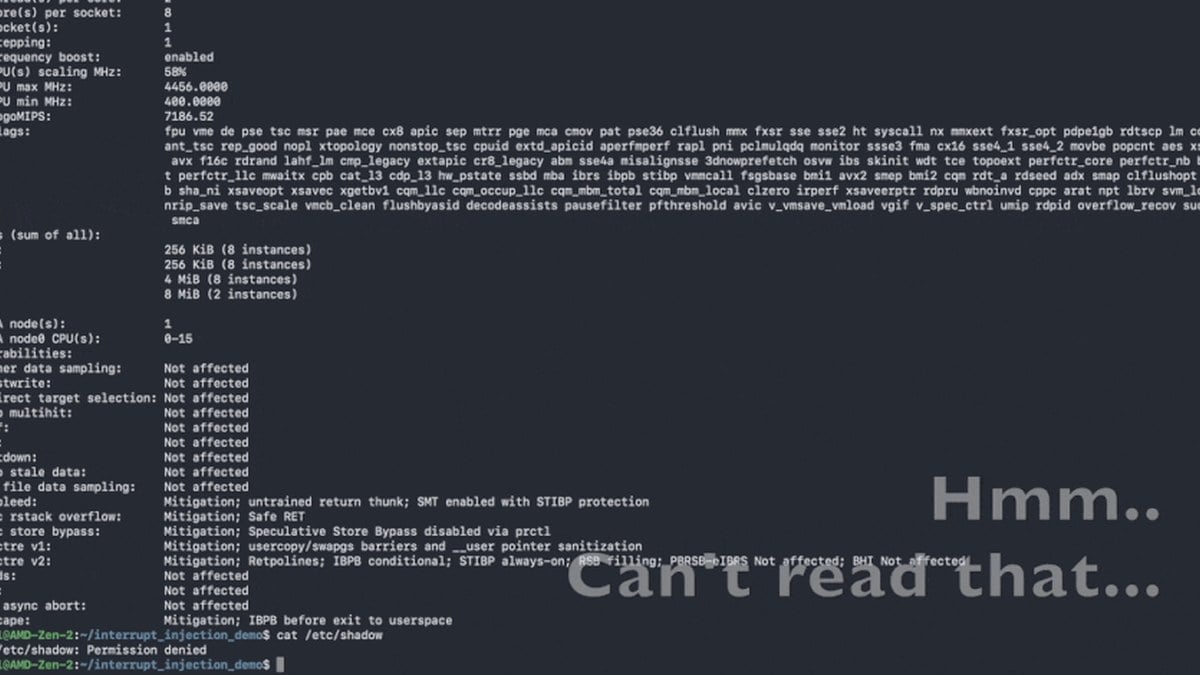
- Key facts & numbers: MIT CSAIL researchers Daniël Trujillo and Mengjia Yan disclosed INTERRUPT INJECTION — an unprivileged attack that times a hardware interrupt to land between a CPU's branch-predictor sanitization and its use, re-poisoning the predictor after the defense has run. On AMD Zen 2 running Linux 6.14 with every default Spectre v2 mitigation enabled, the exploit leaked arbitrary kernel memory at 5.47 bytes per second with 91.97% accuracy, successfully reading /etc/shadow in five of ten attempts. AMD engineers Borislav Petkov and David Kaplan landed the Linux kernel fix on June 2 under the commit "x86/bugs: Make Safe-RET robust against interrupt injection," one of two remediation routes the paper proposed.
- What happens next: AMD's bulletin lists no CVE — admins must find the fix by commit name. Intel paid the bounty but says no fix needed, despite mispredictions on its own chips.
- MIT CSAIL researchers Daniël Trujillo and Mengjia Yan disclosed INTERRUPT INJECTION — an unprivileged attack that times a hardware interrupt to land between a CPU's branch-predictor sanitization and its use, re-poisoning the predictor after the defense has run.
- On AMD Zen 2 running Linux 6.14 with every default Spectre v2 mitigation enabled, the exploit leaked arbitrary kernel memory at 5.47 bytes per second with 91.97% accuracy, successfully reading /etc/shadow in five of ten attempts.
- AMD engineers Borislav Petkov and David Kaplan landed the Linux kernel fix on June 2 under the commit "x86/bugs: Make Safe-RET robust against interrupt injection," one of two remediation routes the paper proposed.
- AMD's August 6 bulletin AMD-SB-7061 names Zen 1 through Zen 4 as affected but lists no CVE, no patch reference, and no kernel version, and neither the bulletin nor MIT's announcement points to the kernel commit.
Why It Matters
AMD shipped a Linux kernel patch but published no CVE or patch reference, forcing admins to track the fix by commit name. Intel paid the bug bounty yet called mitigation unnecessary, despite the researchers' argument that an end-to-end Intel exploit is feasible by combining their primitive with prior disclosure-gadget work.
Sources Cited
Related Coverage
Ask SkimNews