OpenAI's AI Finds and Patches 948 Linux Security Flaws
The 30-Second Skim
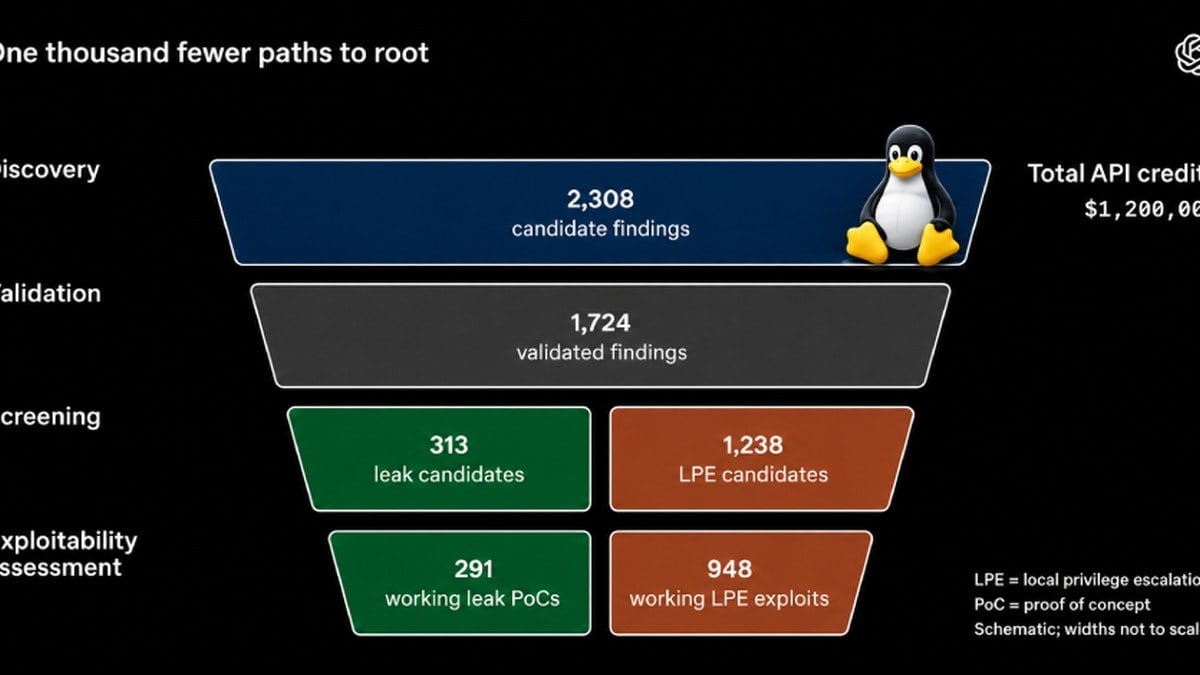
- What happened: OpenAI tested a prototype cyber-focused AI model on Linux kernel security, automating the discovery, validation, and patching of vulnerabilities. The 30-hour run produced 948 working root-escalation exploits alongside validated fixes.
- Key facts & numbers: The pipeline analyzed 2,308 candidate Linux kernel findings, narrowing them to 948 confirmed local privilege-escalation flaws. The operation incurred $1.2 million in API costs, according to BigGo Finance and OpenAI's report.
- What happens next: Linux maintainers are expected to review and integrate the AI-generated patches into upcoming kernel updates, while OpenAI evaluates scaling the pipeline for broader OS and software coverage.
Why It Matters
This demonstration marks a shift in cybersecurity: AI is no longer just a tool for finding bugs but can now autonomously validate and patch them at scale. The $1.2 million cost raises questions about economic viability, but the speed—948 fixes in 30 hours—suggests a future where AI defends systems faster than humans can.
The broader implication is a potential arms race: if AI can generate 948 exploits, it could also be weaponized. However, OpenAI’s focus on defensive automation sets a precedent for responsible use. Enterprises may soon adopt similar pipelines, pressuring rivals and open-source projects to integrate AI into their security workflows or risk falling behind.
How Outlets Are Framing It
- [The Hacker News / Technical Exploit Focus]: Emphasizes the AI’s ability to generate 948 working root-escalation exploits, framing it as a breakthrough in offensive security automation.
- [The Indian Express / Solution-Oriented Lens]: Highlights OpenAI’s dual role in finding and patching flaws, positioning the story as a win for AI-driven defensive cybersecurity.
- [BigGo Finance / Cost & Investment Angle]: Focuses on the $1.2 million API cost, questioning scalability and ROI for AI-powered security at this expense level.
Background & Timeline
- November 2026: OpenAI publicly detailed its AI pipeline after a 30-hour run that identified and patched 948 Linux kernel privilege-escalation flaws.
- Prior to Nov 2026: Rising interest in AI for cybersecurity led to experimental models targeting open-source software, setting the stage for automated vulnerability workflows.
Sources Cited
- The Hacker News — OpenAI AI Pipeline Generates 948 Linux Root Escalation Exploits in 30-Hour Run
- Unite.AI — OpenAI Pipeline Finds 948 Linux Kernel Privilege Escalation Flaws
- www.tokenpost.com — OpenAI Pipeline Finds 948 Linux Kernel Flaws and Generates Patches
- BigGo Finance — OpenAI's AI Pipeline Uncovers 948 Linux Kernel Privilege-Escalation Flaws at a Total Cost of $1.21 Million
- The Indian Express — OpenAI says its AI pipeline found, patched 948 Linux security flaws in hours
Related Coverage
Ask SkimNews