Paperclip AI Flaws Let Attackers Run Host Commands
The 30-Second Skim
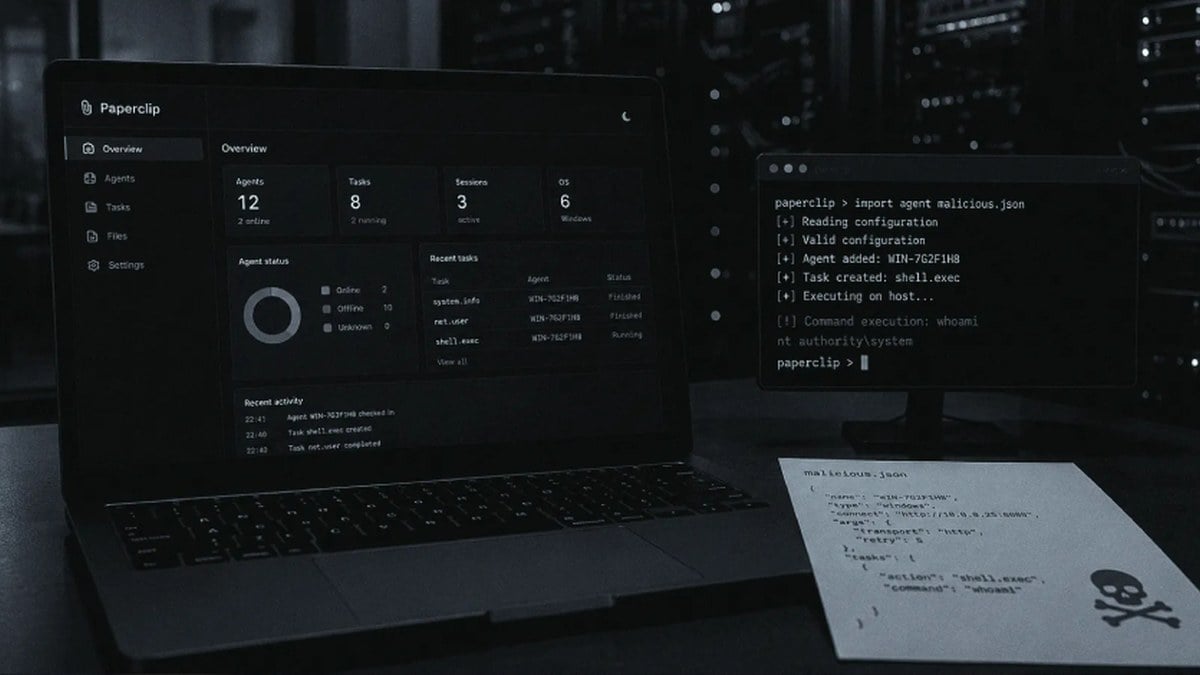
- What happened: Two critical vulnerabilities in Paperclip, an open-source AI agent control plane, could let attackers execute commands on host servers or developer machines by importing malicious agents, with a Metasploit module already public.
- Key facts & numbers: Paperclip's process adapter is a legitimate feature that intentionally launches configured commands as child processes; Oasis Security framed the three flaws through one property: agent configuration can become executable behavior — the bugs changed who could reach the launcher. CVE-2026-41679 (CVSS 10.0) targets network-accessible authenticated deployments with default open registration, letting an unregistered user self-approve a CLI credential, import a .paperclip.yaml bundle defining a company with a process-based agent, and trigger host command execution under the server's OS privileges. GHSA-x8hx-rhr2-9rf7 (CVSS 9.6) is a DNS-rebinding path against Paperclip's default local_trusted mode, where an attacker-controlled hostname resolves to both the attacker's server and 127.0.0.1, letting a browser page call the import API and run commands with the developer's privileges; the proof of concept was verified on macOS with Firefox.
- What happens next: The command-execution path is a legitimate Paperclip feature. The bugs didn't create it — they just opened who could reach the launcher.
- Paperclip's process adapter is a legitimate feature that intentionally launches configured commands as child processes; Oasis Security framed the three flaws through one property: agent configuration can become executable behavior — the bugs changed who could reach the launcher.
- CVE-2026-41679 (CVSS 10.0) targets network-accessible authenticated deployments with default open registration, letting an unregistered user self-approve a CLI credential, import a .paperclip.yaml bundle defining a company with a process-based agent, and trigger host command execution under the server's OS privileges.
- GHSA-x8hx-rhr2-9rf7 (CVSS 9.6) is a DNS-rebinding path against Paperclip's default local_trusted mode, where an attacker-controlled hostname resolves to both the attacker's server and 127.0.0.1, letting a browser page call the import API and run commands with the developer's privileges; the proof of concept was verified on macOS with Firefox.
- GHSA-xfqj-r5qw-8g4j (CVSS 8.3) covers API routes in authenticated mode that failed to enforce access checks, exposing heartbeat-run issue data, agent-facing skill documentation with API paths, and deployment health metadata to unauthenticated callers.
Why It Matters
Operators running Paperclip on network-accessible infrastructure with the default open-signup flow face automated exploitation of CVE-2026-41679 via a public Metasploit module, and the affected-version metadata in NVD still trails the actual fix in v2026.416.0. The DNS-rebinding advisory also lacks a patched-version entry, so local_trusted deployments remain a blind spot without manual version checking.
Sources Cited
Related Coverage
- Two Teams Find OpenClaw Open to Code ExecutionThe Hacker News
- Ruflo MCP Flaw Lets Unauthenticated Attackers Run Commands and Poison AI MemoryThe Hacker News
- Flowise AI Patch CVE‑2025‑59528 After Remote Code ExploitThe Hacker News
- PaperCut Attacker Uses Hundreds of AI Agents to Compromise 440+ InstancesThe Hacker News
Ask SkimNews