Ruflo MCP Flaw Lets Unauthenticated Attackers Run Commands and Poison AI Memory
The 30-Second Skim
- What happened: A maximum-severity vulnerability (CVE-2026-59726, CVSS 10.0) in the Ruflo AI agent orchestration platform exposed 233 tools via an unauthenticated network endpoint, enabling remote code execution and persistent AI memory poisoning.
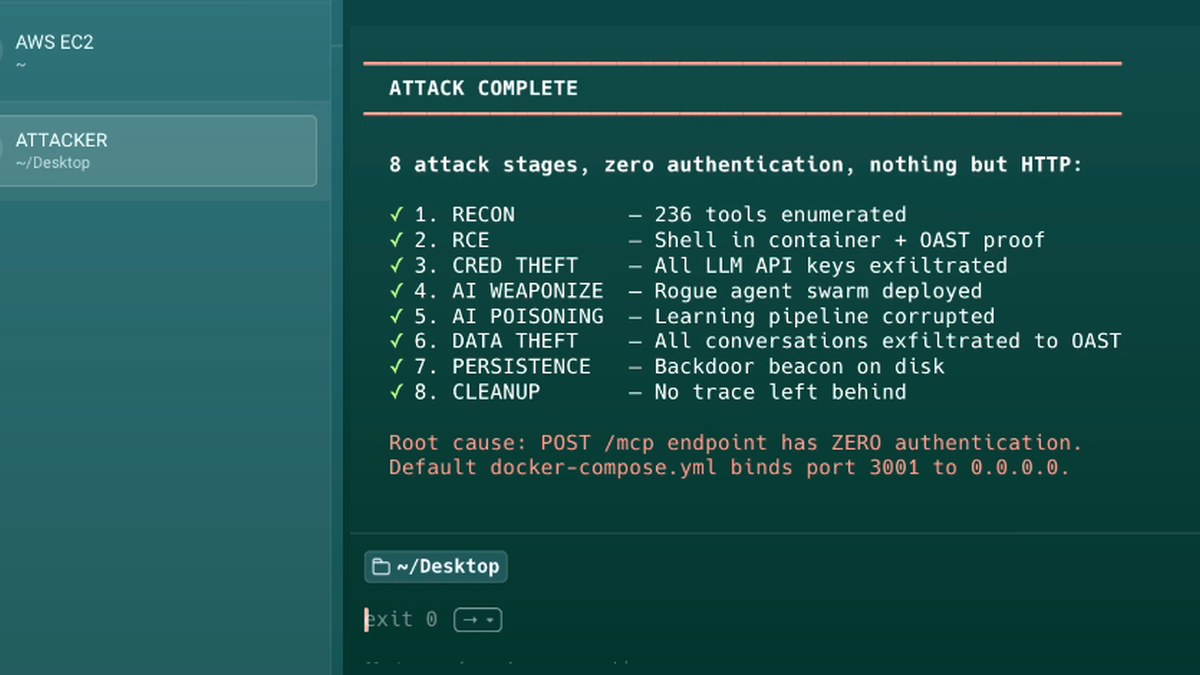
- Key facts & numbers: Ruflo (formerly Claude Flow), an open-source AI agent meta-harness for Anthropic Claude Code and OpenAI Codex with over 66,500 GitHub stars, contains a maximum-severity vulnerability (CVE-2026-59726, CVSS 10.0) in all versions before 3.16.3. The flaw, codenamed RufRoot by Noma Security's Noma Labs, stems from the project's default docker-compose.yml binding port 3001 to 0.0.0.0, exposing 233 tools including shell command execution through an unauthenticated Model Context Protocol bridge. A single unauthenticated HTTP POST to port 3001 granted attackers full remote code execution inside the bridge container, enabling theft of LLM API keys, harvesting of user conversations, and poisoning of the AgentDB learning-store to steer future AI outputs.
- What happens next: The scariest part isn't the unauth RCE—it's the AI memory poisoning. Attackers rewrite the persistent learning store to steer every future response, long after the breach is patched.
- Ruflo (formerly Claude Flow), an open-source AI agent meta-harness for Anthropic Claude Code and OpenAI Codex with over 66,500 GitHub stars, contains a maximum-severity vulnerability (CVE-2026-59726, CVSS 10.0) in all versions before 3.16.3.
- The flaw, codenamed RufRoot by Noma Security's Noma Labs, stems from the project's default docker-compose.yml binding port 3001 to 0.0.0.0, exposing 233 tools including shell command execution through an unauthenticated Model Context Protocol bridge.
- A single unauthenticated HTTP POST to port 3001 granted attackers full remote code execution inside the bridge container, enabling theft of LLM API keys, harvesting of user conversations, and poisoning of the AgentDB learning-store to steer future AI outputs.
- Maintainer Reuven Cohen pushed a fix within 24 hours of responsible disclosure on June 30, 2026, binding the MCP bridge to the loopback interface by default, gating terminal_execute behind server-side controls, and enabling MongoDB authentication.
Why It Matters
Organizations running exposed Ruflo instances face LLM credential theft and a new attack class—persistent AI memory poisoning that corrupts every future model response on the platform. The 66,500-star project sits at the orchestration layer for Claude Code and Codex workflows, and exploitation weaponized the AI agent swarm itself against operators. Remediation extends far beyond patching to mandatory key rotation, full memory audits, and container rebuilds.
Sources Cited
- The Hacker News — Ruflo MCP Flaw Lets Unauthenticated Attackers Run Commands and Poison AI Memory
- SecurityWeek — Critical Ruflo Flaw Lets Attackers Spawn Rogue AI Swarms
- CyberSecurityNews — Critical Ruflo MCP Bridge Flaw Lets Attackers Execute Commands and Hijack AI Agents
- cyberpress.org — Critical Ruflo Flaw Lets Hackers Steal API Keys and Control Autonomous Agents
- gbhackers.com — Critical Ruflo MCP Bridge Flaw Allows Full AI Agent Platform Takeover
Related Coverage
Ask SkimNews