Tesla FSD v14 nearly hits ditch at 110 km/h
The 30-Second Skim
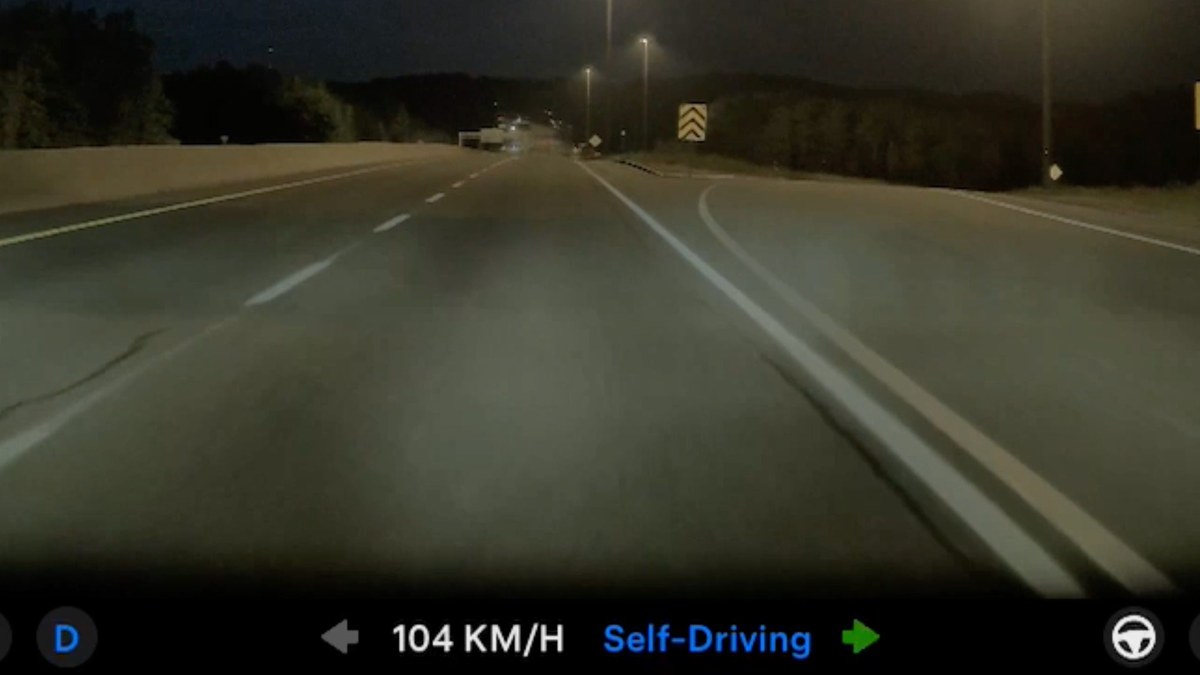
- What happened: Tesla's Full Self-Driving v14.3.6 attempted to take a highway exit the car had already passed at 110 km/h on an empty Quebec highway, nearly driving into a ditch before the driver intervened.
- Key facts & numbers: Tesla FSD v14.3.6 activated its right turn signal and began pulling toward the shoulder for exit 217 on Autoroute 55 in Quebec's Mauricie region at 110 km/h, even though the ramp had already passed, committing to a maneuver that would have driven the car straight into a ditch The driver grabbed the wheel at approximately 102 km/h, with the speed readout dropping from 110 to 102 as the car committed to the turn while still displaying "Self-Driving" on the screen Tesla's v14.3.6 release notes cite an upgraded reinforcement learning training stage, a rewritten MLIR AI compiler delivering "20% faster reaction time," and improvements reducing unnecessary disengagements
- What happens next: Tesla brags about "20% faster reaction time" in v14.3.6 — meanwhile it tried to turn into a ditch at 110 km/h on an empty, perfectly-marked highway. The bug isn't the scary part. The scary part is nothing was wrong.
- Tesla FSD v14.3.6 activated its right turn signal and began pulling toward the shoulder for exit 217 on Autoroute 55 in Quebec's Mauricie region at 110 km/h, even though the ramp had already passed, committing to a maneuver that would have driven the car straight into a ditch
- The driver grabbed the wheel at approximately 102 km/h, with the speed readout dropping from 110 to 102 as the car committed to the turn while still displaying "Self-Driving" on the screen
- Tesla's v14.3.6 release notes cite an upgraded reinforcement learning training stage, a rewritten MLIR AI compiler delivering "20% faster reaction time," and improvements reducing unnecessary disengagements
- Tesla reported a record 207 Autopilot and FSD crashes to NHTSA in a single month, with narratives redacted on 99.9% of its 3,763 driver-assist crash reports since 2019
Why It Matters
The near-miss happened under conditions specifically cited as the system's strongest case — divided highway, night, zero traffic, fresh lane markings — yet FSD still committed to a turn that would have driven into a ditch at 110 km/h. For Tesla, the gap between Musk's year-end unsupervised-FSD promises and a car that cannot reliably distinguish a passed exit from an upcoming one is the credibility problem Electrek flags as probably the company's worst-ever strategic move.
Sources Cited
Related Coverage
Ask SkimNews