Will we put data centers in space?
The 30-Second Skim
- What happened: A feasibility assessment finds orbital data centers unlikely to represent a meaningful share of AI compute before 2030, but Starship reuse at roughly $50/kg could make orbital power cheaper than terrestrial sources within 3–5 years if development stays on track.
- Key facts & numbers: SpaceX filed with the FCC in early 2026 for authorization to launch and operate up to one million data-center satellites; the assessment identifies Starship as the only vehicle on track, with development targeted for late 2026 and meaningful scale possible within 3–5 years if development stays roughly on track. Google announced Project Suncatcher in November 2025 to place TPU-equipped satellites in dawn-dusk sun-synchronous orbit; the source also lists SpaceX, Blue Origin, Ramon.Space, Starcloud and Aetherflux among entrants pursuing orbital compute. NVIDIA announced the Space-1 Vera Rubin Module at GTC in March 2026 as a dedicated space-rated GPU platform for orbital AI workloads.
- What happens next: The consensus pitch is power; the buried twist is repairability—dead chips drive a ~40% launch and non-chip hardware overbuy.
- SpaceX filed with the FCC in early 2026 for authorization to launch and operate up to one million data-center satellites; the assessment identifies Starship as the only vehicle on track, with development targeted for late 2026 and meaningful scale possible within 3–5 years if development stays roughly on track.
- Google announced Project Suncatcher in November 2025 to place TPU-equipped satellites in dawn-dusk sun-synchronous orbit; the source also lists SpaceX, Blue Origin, Ramon.Space, Starcloud and Aetherflux among entrants pursuing orbital compute.
- NVIDIA announced the Space-1 Vera Rubin Module at GTC in March 2026 as a dedicated space-rated GPU platform for orbital AI workloads.
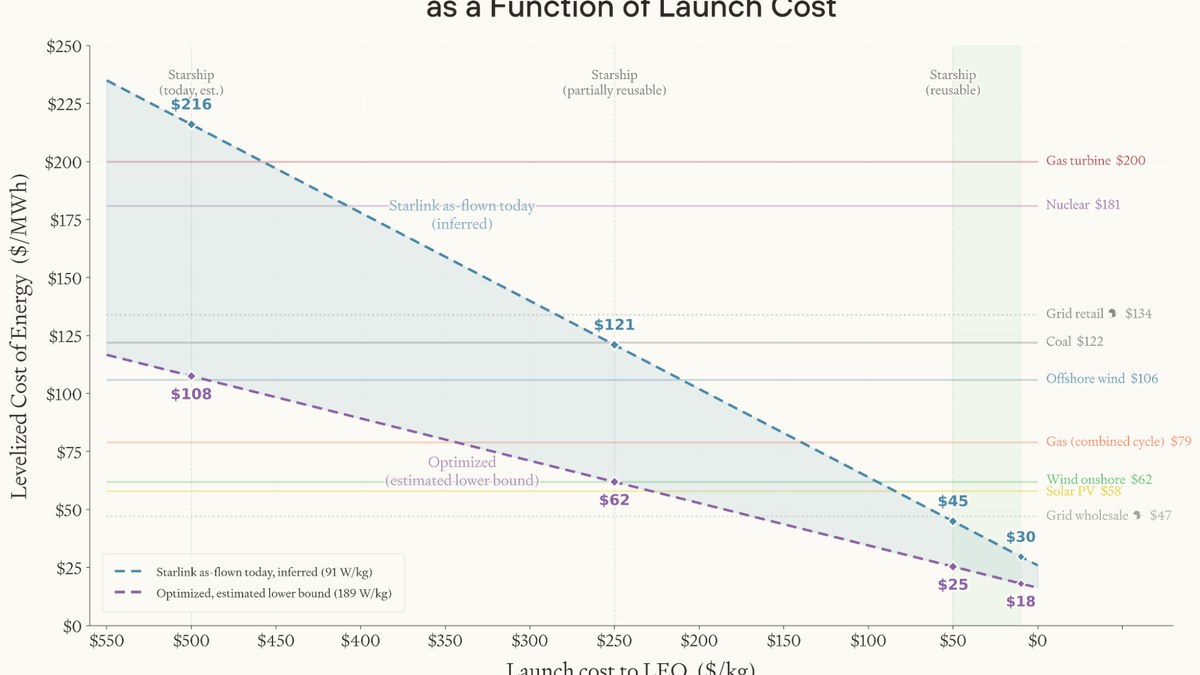
- Starship is the economic hinge: at a $50/kg launch cost, space-based solar is modeled at $25–$45/MWh, below all current terrestrial options; around $100/kg, the model finds orbital data centers competitive with a bullish terrestrial buildout if server and cooling mass fall modestly.
Why It Matters
AI developers have a potential route around multi-year grid queues, but launch price decides the case: roughly $100/kg with modest mass reductions can match a bullish terrestrial buildout, while $50/kg space solar reaches $25–$45/MWh. SpaceX’s filing for up to one million satellites and its status as the only launch vehicle on track place it at the center of that path.
Sources Cited
- Hacker News — Will we put data centers in space?
Related Coverage
- Tech Firms Eye Space Data Centers After Texas Blue WaveWired
- SpaceX Plans 1M Orbital Data Centers Amid Tech RaceMIT Technology Review
- Can Tech Companies Like Google Really Put Data Centers in Space?NYT Tech
- Space datacenters proposed by Musk and Bezos ‘catastrophic’ for planet, experts warnThe Guardian Science
Ask SkimNews