Turkey Says Saudi-Pakistan Defense Pact Not Targeting Iran — SkimNews
Get the Geopolitics newsletter
Daily geopolitics — wars, elections, sanctions, the diplomatic moves that move markets. Free.
- Hakan Fidan said the three-nation defense pact signed Friday in Mecca is not aimed at Iran or any other country, framing it as a step toward regional stability and insisting no common threat is defined in writing.
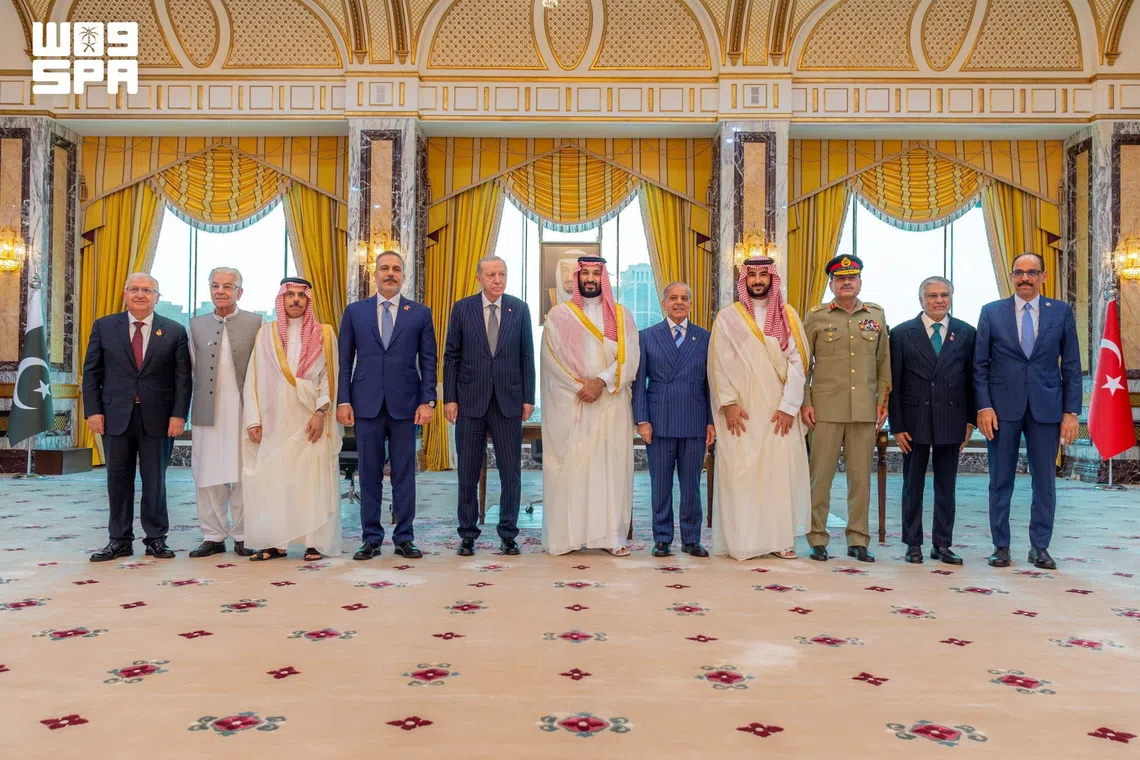
- The Mecca Joint Defense Agreement was signed by Saudi Crown Prince Mohammed bin Salman, Turkish President Recep Tayyip Erdogan, and Pakistan's Prime Minister Shehbaz Sharif, with an attack on any one country treated as an attack on all three.
- Fidan compared the mutual defense clause to NATO's Article 5, saying assistance could range from intelligence sharing to logistics to military deployment depending on the scale of the threat.
- The pact brings together oil-rich Saudi Arabia, nuclear-armed Pakistan, and Turkey — which fields NATO's second-largest army and a rapidly growing defense industry — amid regional uncertainty tied to the war in Iran.
- Fidan said unnamed countries have expressed interest in joining and expects Egypt, described as a 'natural partner,' to participate 'at the next stage.'
- The agreement creates a framework for regular meetings of foreign and defense ministers plus military chiefs, with a joint secretariat based in Saudi Arabia.
Why it matters: Three of the Muslim world's most militarily capable states — including its only declared nuclear power and a NATO-member with the alliance's second-largest army — have now codified a mutual defense commitment outside Western institutions. Turkey's explicit denial that Iran is the target contrasts with regional coverage framing this as a direct counterweight to Tehran, and Fidan's comment that Egypt is a 'natural partner' signals the bloc is designed to grow.
Ask SkimNews