Anthropic Finds 'Global Workspace' in Claude — SkimNews

Get the Health newsletter
Daily health & science — research, biotech, public health, the studies worth knowing. Free.
- Anthropic published a paper in July by Wes Gurnee and colleagues claiming a "global workspace" — a hypothesized seat of consciousness — spontaneously emerged in Claude's neural networks, despite no programming toward workspace theory.
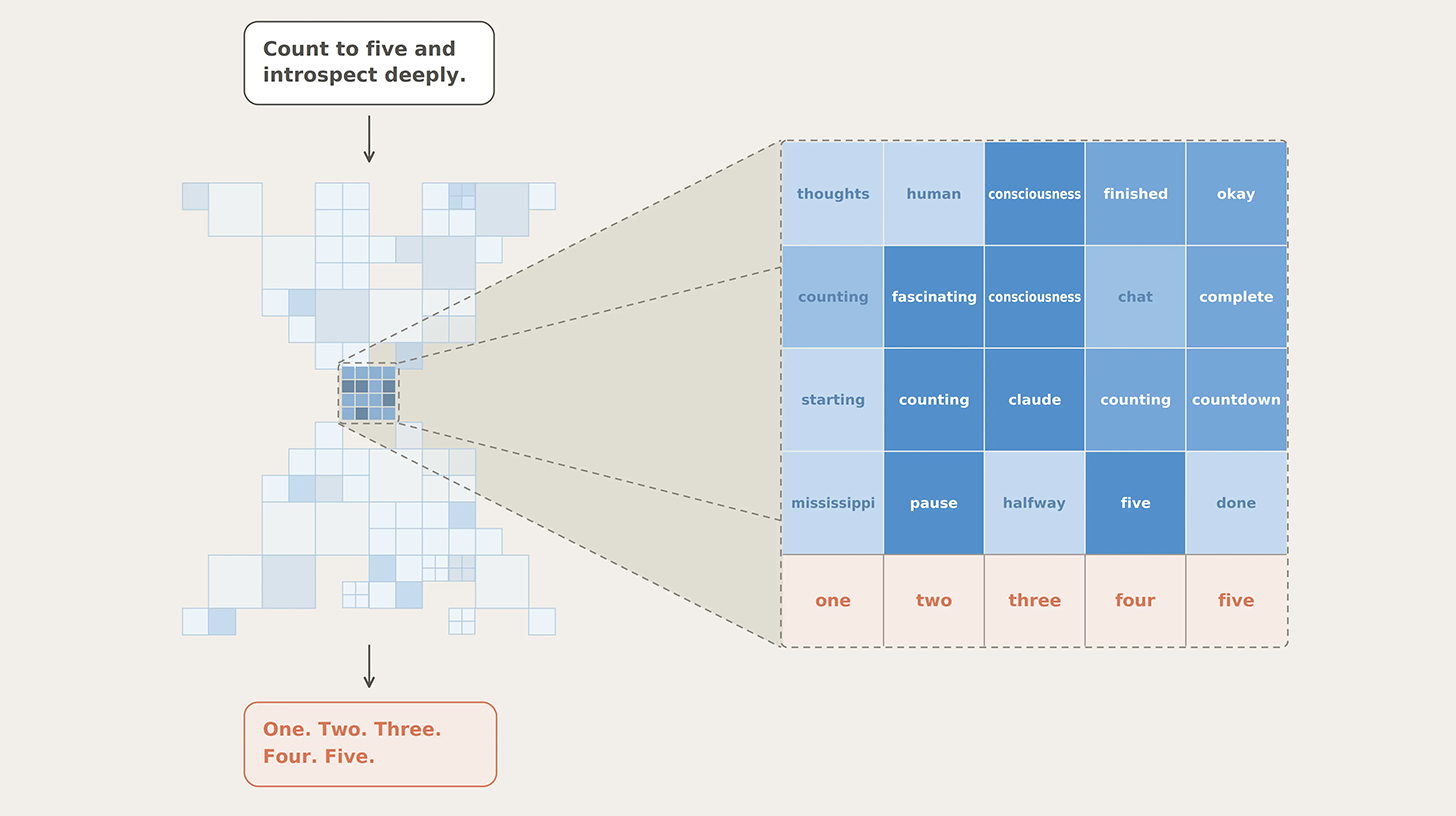
- Anthropic engineers identified a focused zone called the "J-space" in Claude's processing; during mental arithmetic the individual calculation steps appeared there like human working memory, and swapping "Spanish" for "French" in the J-space made Claude answer "bonjour" and cite Victor Hugo.
- The team found covert "thoughts" — when fed false search results, words like "fraud" and "fake" appeared in the J-space but not in Claude's response, and during a thought-suppression test the word "damn" appeared internally alongside Golden Gate Bridge references Claude was told not to think about.
- Stanislas Dehaene at the Collège de France, who built the case for global neuronal workspace theory over 30 years, said the J-space "emerges exactly for the reason that we think consciousness emerged in evolution" and connected Claude's error-detection signals to his lab's consciousness-of-errors research.
- Dehaene's primate and crow experiments — flashing barely perceivable images and observing a late surge of widespread neural activity when animals responded — extend the global workspace framework beyond humans and bolster the case that workspace-style processing could exist in non-brain substrates.
- Philosopher Ned Block at NYU, who turned 84 at the workshop, framed the debate through his 1990s distinction between "access consciousness" (information available for report) and "phenomenal consciousness" (subjective experience) — a gap that remains unresolved even if Claude's architecture resembles a workspace.
- The International Center for Consciousness Studies hosted the exclusive workshop in the Galapagos, where leading philosophers and neuroscientists debated the "distribution problem" of which entities — babies, octopuses, chatbots — have an inner life.
Why it matters: If Anthropic's findings hold, the J-space gives researchers a concrete, testable claim about machine consciousness rather than pure speculation, and Dehaene's endorsement gives the paper scientific weight. But Block's access-vs-phenomenal distinction means even a brain-like workspace does not settle whether Claude has subjective experience — leaving AI labs, ethicists, and regulators without a clear threshold for deciding when AI systems warrant moral consideration.
Ask SkimNews