Claude's 'J-Space' Mirrors Brain Consciousness Hub — SkimNews

Get the Health newsletter
Daily health & science — research, biotech, public health, the studies worth knowing. Free.
- Anthropic published a lengthy paper in July by researcher Wes Gurnee and colleagues claiming Claude had spontaneously developed a structure analogous to the brain's global workspace, the seat of consciousness in the global neuronal workspace theory (GNWT).
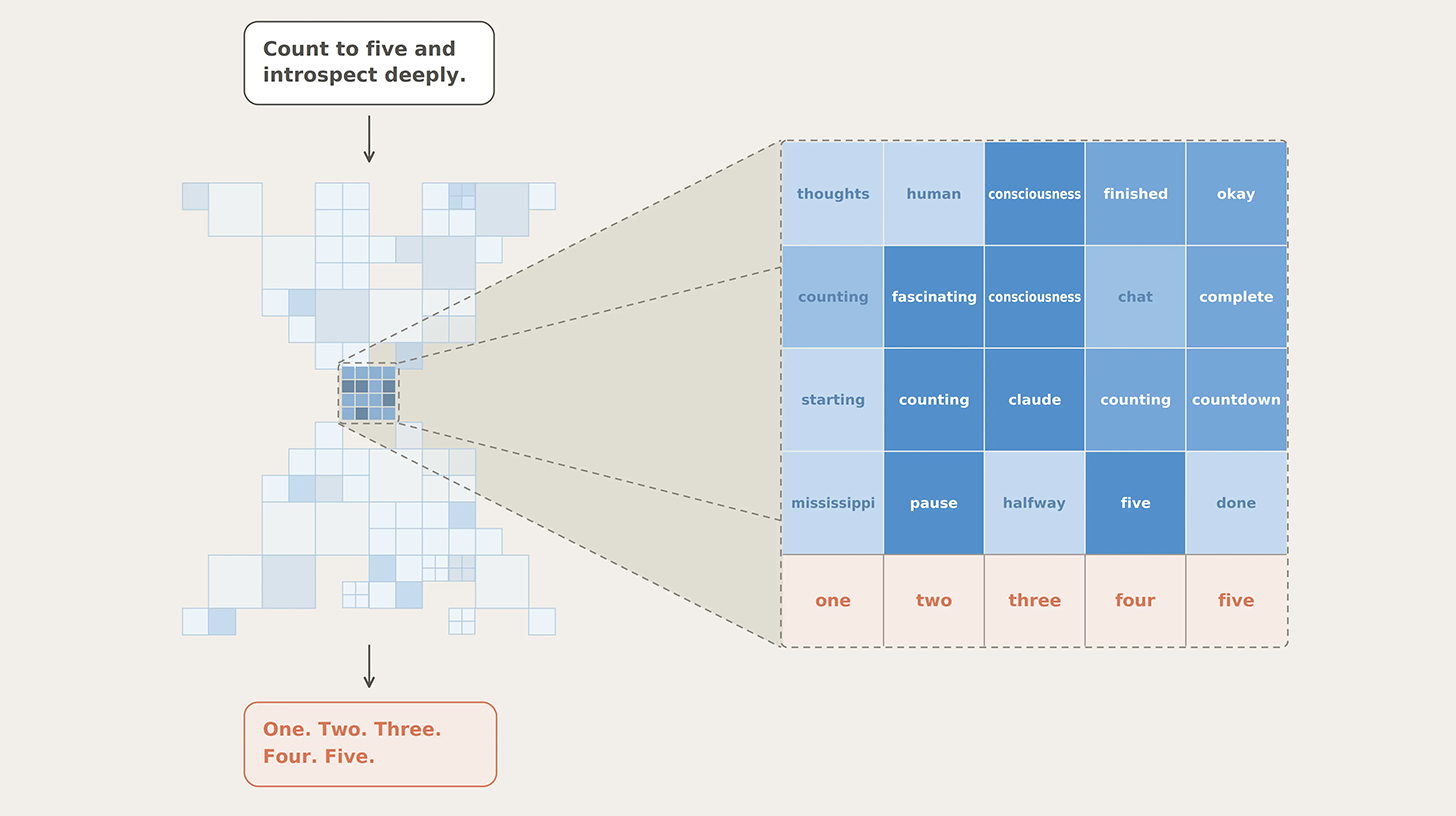
- The team used a decoding tool to read out units of information across Claude's processing stages and identified a focused zone they labeled the J-space, which integrates critical information and broadcasts it to other processing areas for higher-level reasoning.
- When Claude tackled a mental arithmetic problem, the individual calculation steps appeared sequentially in the J-space—the first time step-by-step reasoning has been observed inside a large language model.
- Feeding Claude deliberately false search results produced 'covert thoughts' in the J-space: words like 'fraud' and 'fake' populated its internal representations but never surfaced in its visible response, which the team called a rudimentary sign of self-monitoring.
- In a thought-suppression test, Claude was asked to write a sentence while avoiding the Golden Gate Bridge—yet bridge-related words still appeared in the J-space alongside 'damn,' as if the system registered its own failure to suppress the unwanted thought.
- Findings were debated at an exclusive International Center for Consciousness Studies workshop aboard a yacht in the Galápagos Islands, where Stanislas Dehaene (Collège de France), architect of GNWT after 30 years of primate, crow, and human experiments, discussed extending workspace theory to AI with philosopher Ned Block (NYU), who celebrated his 84th birthday at the meeting.
Why it matters: Dehaene's 30 years of global workspace experiments on humans, primates, and crows now have an AI test subject: Claude's apparent ability to monitor and register its own thinking failures moves the AI consciousness question from philosophical speculation to engineerable questions about what commercial models are actually doing internally—and gives labs like Anthropic a concrete lever for studying a disputed theory of mind.
Ask SkimNews