US Gas Hits $4.11/Gallon, Echoes 1973-74 Crisis Prices — SkimNews
Get the Finance newsletter
Daily finance — markets, central banks, M&A, the prints that move money. Free.
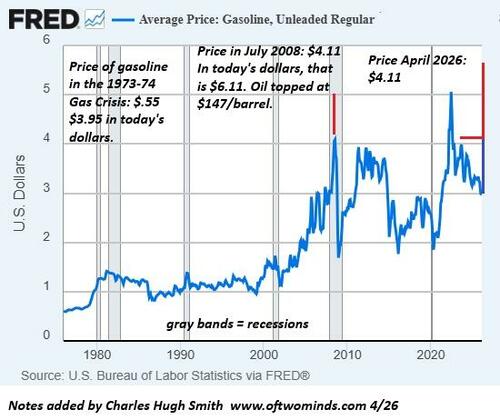
- US gasoline prices have spiked to a $4.11/gallon average as of February 2026, nearly matching the inflation-adjusted price of the 1973-74 Gas Crisis and the nominal July 2008 price (which equals $6.11 in today's dollars)
- Charles Hugh Smith argues that the price of oil alone does not cause recessions — the real trigger is the gap between "happy story" narratives about strong employment, solid corporate profits, and healthy household balance sheets and the underlying reality of debt, inflation, and eroding discretionary income
- Hydrocarbons are the foundation of every industry from green energy to high-tech (including SpaceX and AI data centers) to transport and plastics, meaning energy price spikes cascade economy-wide rather than hitting one sector
- The household debt cycle Smith describes: inflation reduces discretionary income, households borrow to maintain lifestyle, interest and principal payments consume a larger share of earnings, and the eventual retrenchment of spending and credit produces a recession
- The "happy story" narrative sustains confidence and borrowing via wealth effects from credit-asset bubbles — but Smith calls these bubbles "self-liquidating" because debt service continually erodes the discretionary income that powers consumption
- California gasoline is already over $6/gallon and high-fuel-tax states are over $5/gallon, meaning the price levels that preceded past recessions have already been reached regionally without triggering a national downturn
- The top 10% of earners, who hold the lion's share of income-producing assets (real estate, stocks, corporate bonds, enterprises), are the structural backbone of current consumption — Smith identifies a collapse in their confidence as the core fragility if the Everything Bubble pops
Why it matters: Smith's framing implies that watching for a single oil-price threshold (like $147/barrel) is the wrong signal — recession risk depends on the width of the gap between narrative and reality, and that gap is narrowing as average US gasoline at $4.11/gallon already matches inflation-adjusted 1973-74 levels while consumption leans heavily on the top 10% and their asset-bubble confidence.
Ask SkimNews