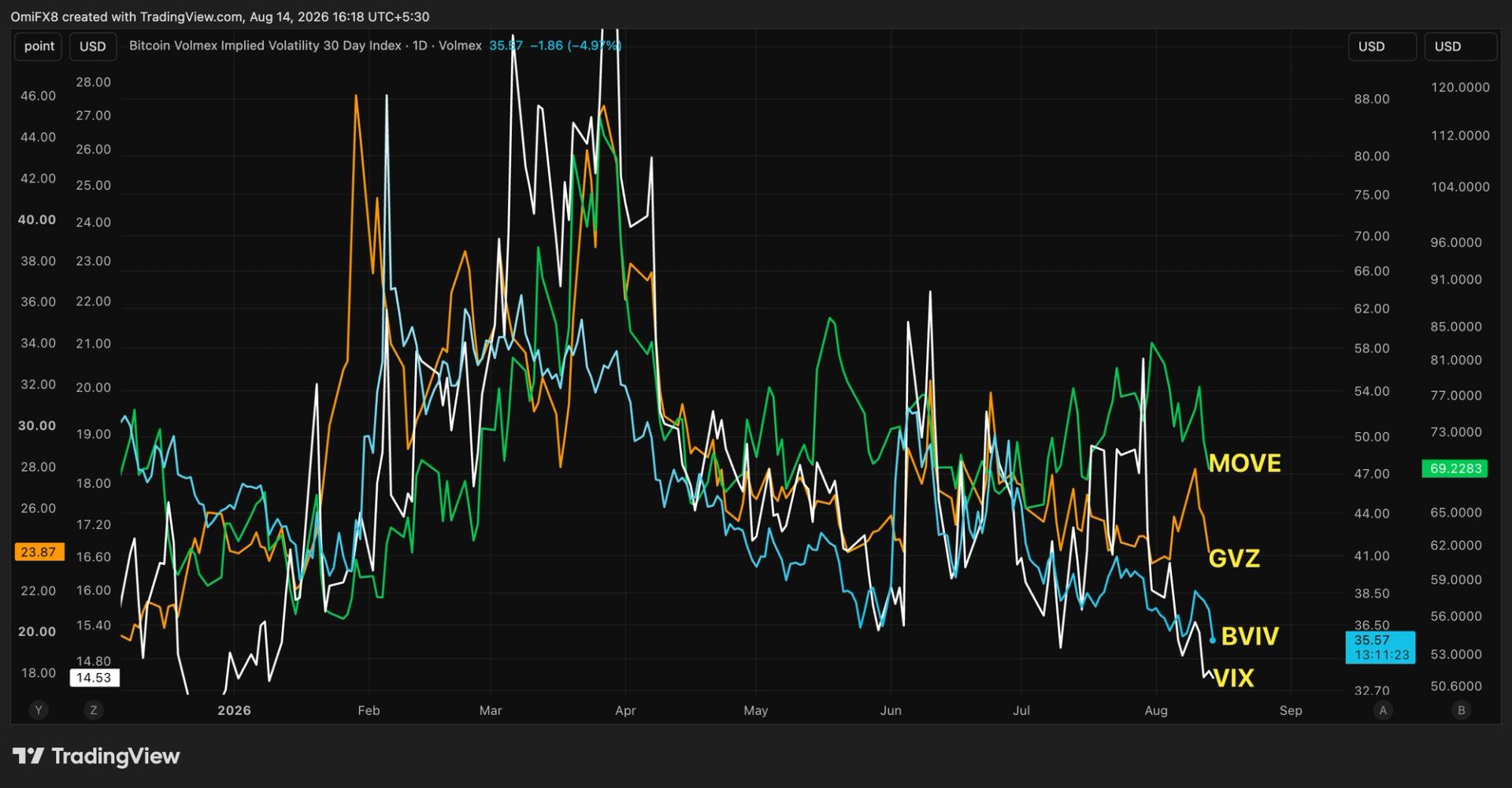
'Don't get too comfortable': Wall Street’s ‘fear gauge’ hits 2026 low — here's why it's unlikely to last — SkimNews

Get the Finance newsletter
Daily finance — markets, central banks, M&A, the prints that move money. Free.
- VIX dropped to 14.2 on Friday, its lowest reading of 2026, with the S&P 500 roughly 16% higher year-to-date and other equity benchmarks touching record highs.
- BTIG's Jonathan Krinsky warned investors are entering the historically choppy mid-August-to-mid-October window in a midterm election year, noting the equal-weight S&P has pulled back at least 7% from its Aug. 18 peak through mid-October in every such year since 1990.
- 2026 market action has logged no 80% downside volume day since October; the typical year sees 21 such days and no year on record has produced fewer than five, Krinsky said.
- Long-end Treasury yields sit near cycle highs even after dovish jobs, CPI, and PPI prints — a divergence BTIG flagged as inconsistent with the calm signaled by the equity rally.
- Susquehanna called the volatility reset 'substantial' even as cross-asset and geopolitical risks remain live, putting two-month implied volatility at 13.5%, close to pre-Iran-war levels.
- IG's Axel Rudolph pointed to 12 straight weeks of equity fund inflows and a surprise 0.6% drop in July retail sales, saying markets look 'a little too comfortable given the risks still lurking beneath the surface.'
Why it matters: Every midterm election year since 1990 has delivered at least a 7% equal-weight S&P pullback between mid-August and mid-October — and that window opens now with VIX at a 2026 low, long-end yields near cycle highs, and the Strait of Hormuz still squeezed. BTIG and Susquehanna frame the calm as a setup, not a verdict, for investors anchored to record highs.
Ask SkimNews