Allen Institute Maps Brain’s Targeted Messaging System — SkimNews
Get the Health newsletter
Daily health & science — research, biotech, public health, the studies worth knowing. Free.
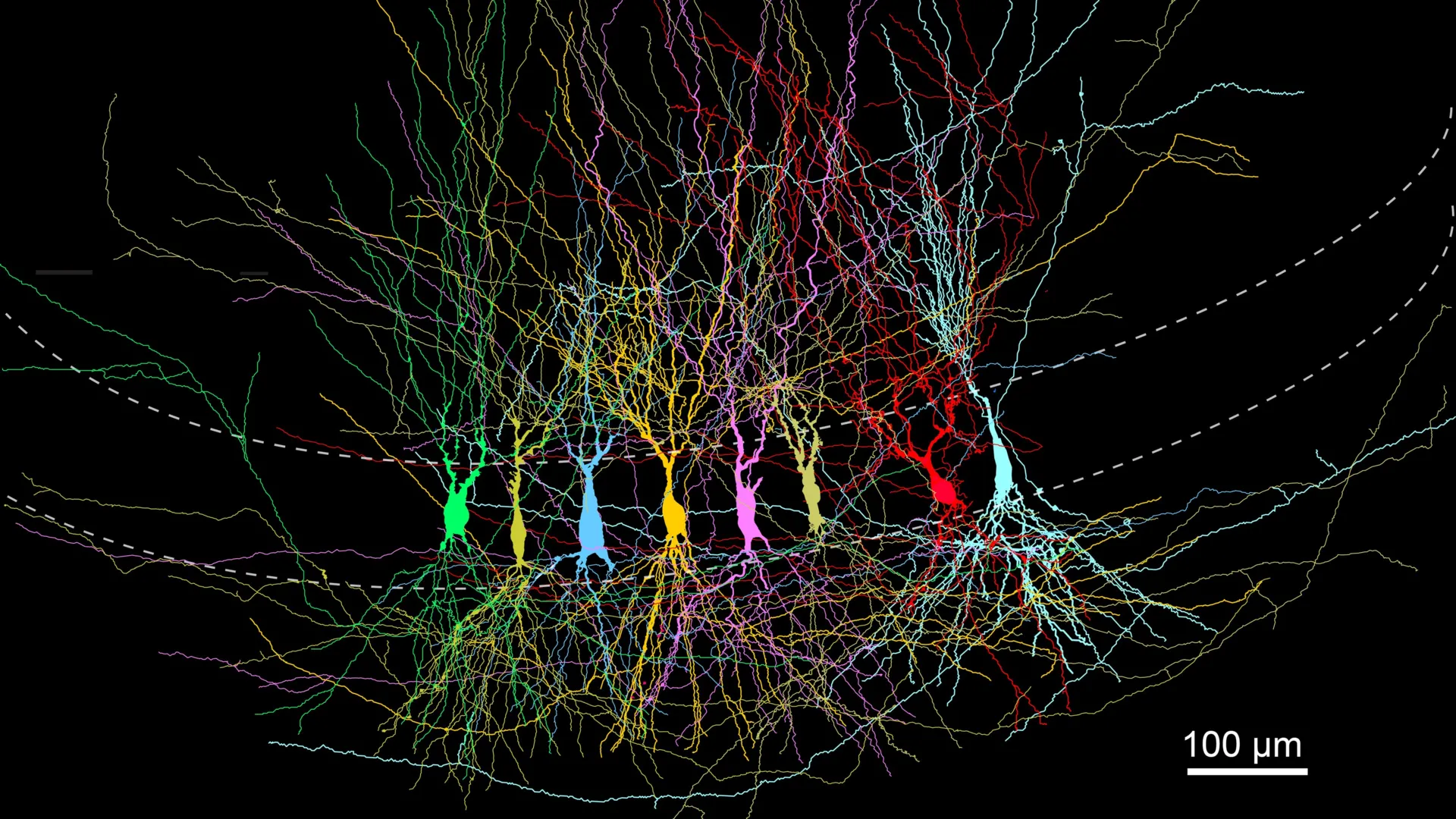
- Allen Institute researchers mapped nearly 35,000 neurons and reconstructed the full structure of exceptionally long locus coeruleus axons, one measuring 70.32 centimeters—the longest neuron ever recorded in a mouse.
- Locus coeruleus (LC) neurons send targeted norepinephrine signals rather than broadcasting uniformly, with dorsal LC cells connecting to the cortex and ventral LC cells projecting to the brainstem and spinal cord.
- Dorsal LC neurons showed increased activity during learning tasks when mice adjusted behavior after negative feedback, linking them directly to cognitive adaptation and decision-making.
- Ventral LC neurons became active just before mice ignored reward-related cues, suggesting a role in regulating whether animals engage with opportunities in their environment.
- Gene expression patterns differ between dorsal and ventral LC neurons, confirming that their functional specialization is reflected at the molecular level, not just anatomically.
- Norepinephrine pathways are organized like a 'postal network' rather than a 'foghorn,' offering a new model for how brain-wide neuromodulation supports attention, learning, and behavior.
Why it matters: This detailed mapping of the locus coeruleus reveals that norepinephrine-based treatments for ADHD, depression, and Alzheimer’s could be refined to target specific circuits, reducing side effects by avoiding broad system-wide activation. The discovery transforms a foundational model of brain signaling used for decades.
Ask SkimNews