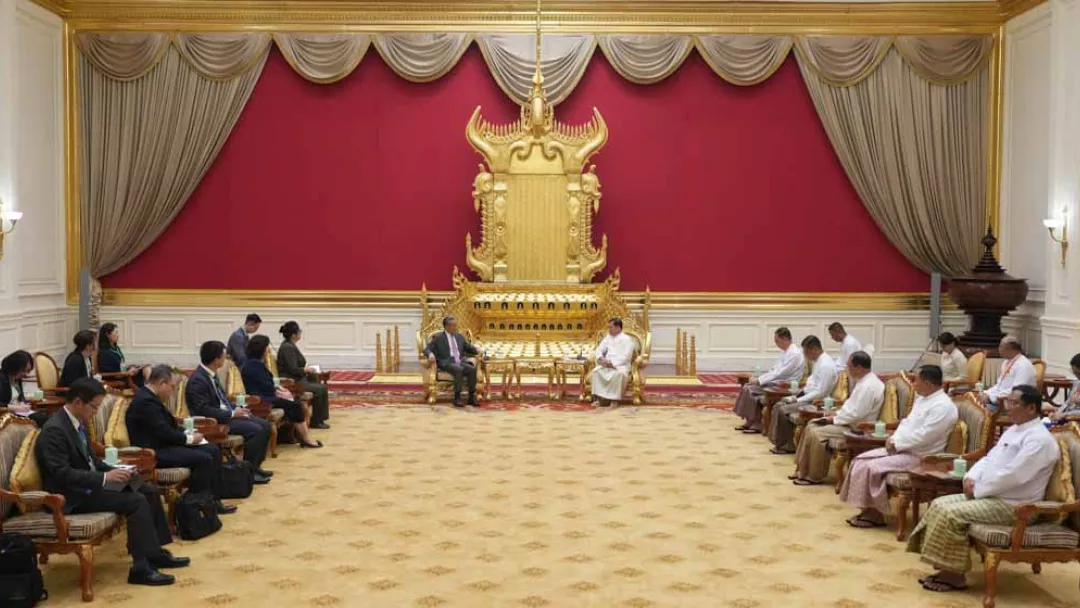
Min Aung Hlaing Claims Presidency as Junta's Grip Erodes — SkimNews

SkimNews Take
The junta's "makeover" and prisoner releases are tactical, aiming to reduce international isolation without ceding actual military control, highlighting the enduring power of symbolic gestures in international relations.
Get the Geopolitics newsletter
Daily geopolitics — wars, elections, sanctions, the diplomatic moves that move markets. Free.
- Min Aung Hlaing shed his military uniform, declared himself president, released elected President Win Myint, reduced Aung San Suu Kyi's sentence and transferred her to house arrest — moves the author frames as a 'political makeover' rather than a democratic transition.
- The junta controls the capital, major airports and the urban cores of Yangon and Mandalay, but ISP-Myanmar estimated in January the regime had lost roughly 38% of territory and not recovered at least 150 overrun bases, while a 2025 ISEAS study said anti-junta groups control as much as half the country with the military holding only about a quarter.
- The Arakan Army now controls most of Rakhine State except for three townships, reducing the military to defending Sittwe, Kyaukphyu and Manaung — a posture the author calls 'less governance than a siege.'
- The National Unity Government (NUG) claims democratic legitimacy from the 2020 election and has built parallel armed and administrative structures, including People’s Defense Forces, though many PDFs operate outside its direct control.
- Myanmar's UN seat remains held by Ambassador Kyaw Moe Tun, aligned with the pre-coup government, while ASEAN stays cautious and divided over the junta's latest attempt to repackage military rule.
- The junta's 100-day peace talks proposal was swiftly rejected by major resistance organizations, who were asked to negotiate with the same power that overthrew an elected government and still relies on airstrikes and mass arrests.
- China is shaping parts of the battlefield by pressuring armed groups it tacitly supports, and Rakhine State is critical to both Beijing's Kyaukphyu Indian Ocean route and India's Kaladan project and Sittwe port interests.
Why it matters: Min Aung Hlaing's new title does not extend his authority: the junta holds only about a quarter of Myanmar while anti-junta forces control up to half, and the regime's peace offer was rejected outright by resistance groups. The UN seat remains with the ousted government, signaling the international community has not legitimized the makeover and the conflict is entering a longer, harsher phase with direct geopolitical stakes for both China and India.
Ask SkimNews