Light-Powered Nanorobots Hunt Bacteria in Liquid — SkimNews
Get the Health newsletter
Daily health & science — research, biotech, public health, the studies worth knowing. Free.
- University of Würzburg researchers led by Professor Bert Hecht have reduced their light-driven microdrones to below one micrometer — roughly 50 times smaller than a human hair — enabling them to operate directly in microbial environments.
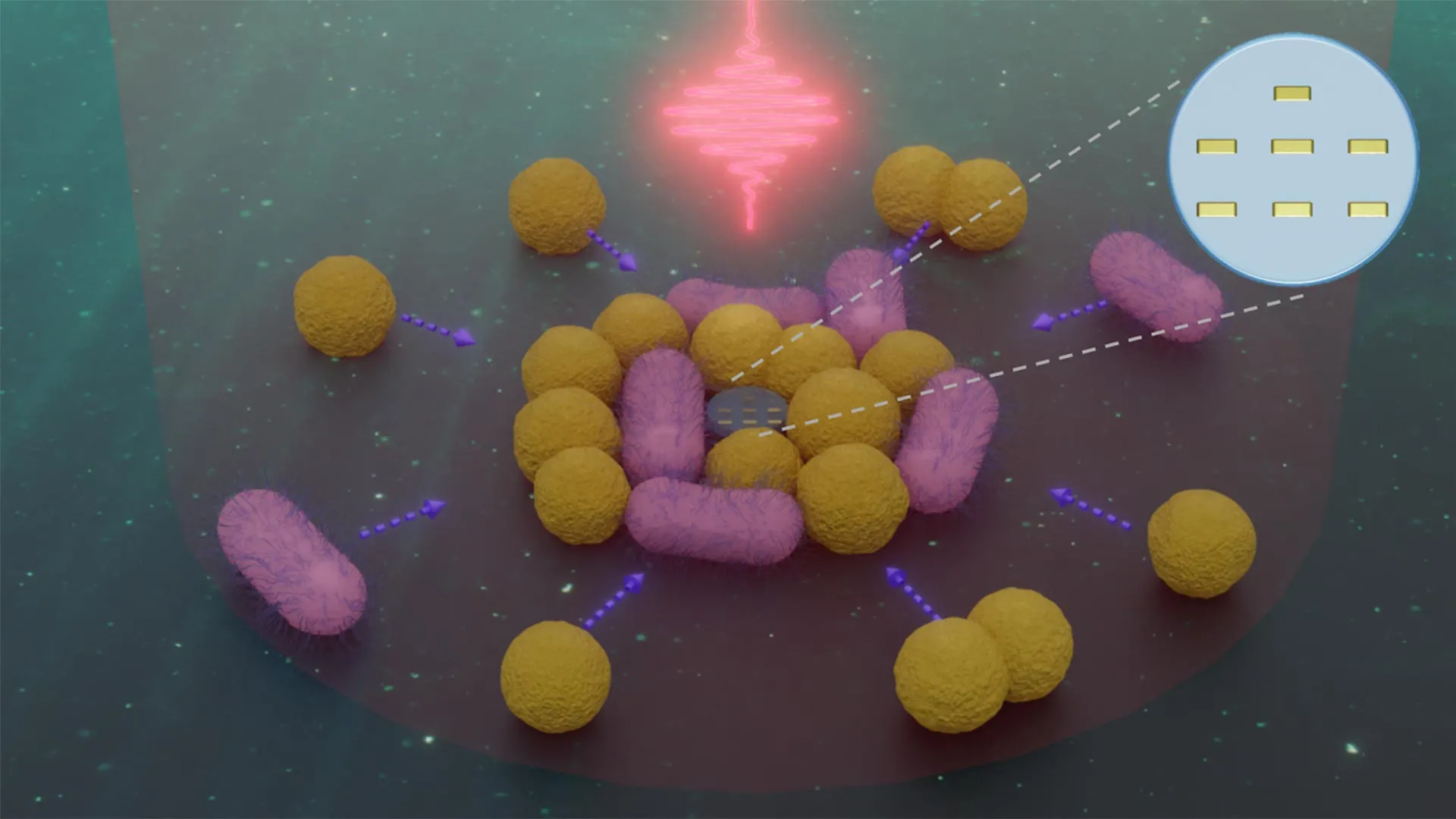
- The nanorobots are propelled by photon recoil from up to four plasmonic nanoantennas that absorb light of a specific color and helicity, then emit it in a set direction, generating enough force to accelerate the tiny devices.
- Steering is achieved by changing the polarization of incoming light, which naturally aligns built-in nanoscale antenna wires and reorients the robot, functioning like a directional control system.
- Lead experimental scientist Jin Qin said the team "built a light-driven nanorobot that can track down and collect bacteria," calling the devices "microscopic cleaning devices" that can selectively capture, carry, and release large numbers of bacteria.
- The nanorobots can execute extremely fast 90° turns for systematic scanning and remain maneuverable even while transporting larger bacterial clusters, though their speed drops under the added load.
- The study, published in Nature Communications (DOI: 10.1038/s41467-026-70685-9), points to future applications in microbiology, biomedical research, and precise manipulation of microscopic materials, according to Hecht.
Why it matters: Hecht's lab has demonstrated a working physical mechanism for actively manipulating individual cells and bacteria in liquid — a capability that has been a persistent challenge at the microscale. For microbiologists and biomedical researchers, this opens a path to hands-on handling of objects too small to manipulate directly, with potential uses in sample preparation and targeted micro-scale interventions.
Ask SkimNews


