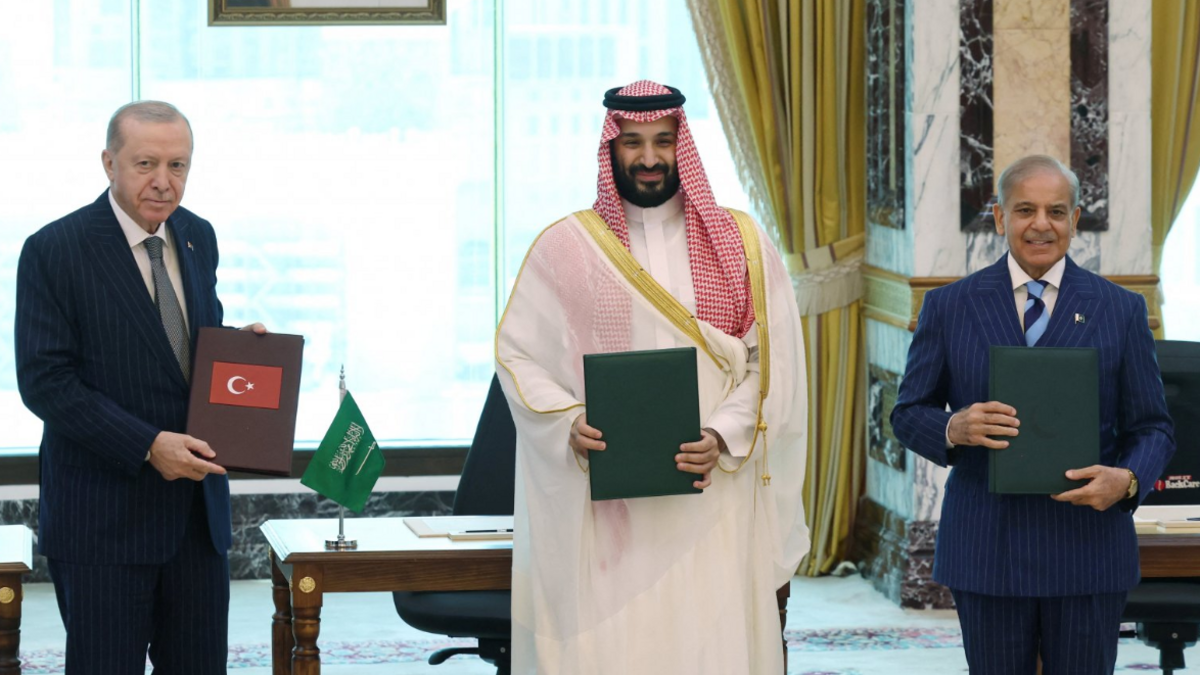
Saudi-Turkey-Pakistan sign Mecca mutual defense pact

Get the Geopolitics newsletter
Daily geopolitics — wars, elections, sanctions, the diplomatic moves that move markets. Free.
- Saudi Arabia, Turkey, and Pakistan signed the Mecca Joint Defense Agreement on Friday, pledging that 'any armed attack against any one of the three states shall be regarded as an attack against them all,' per the document's text.
- Mohammed bin Salman, Recep Erdogan, and Shehbaz Sharif signed the accord, which the German Marshall Fund's Ozgur Unluhisarcikli described to Al Jazeera as a modest 'framework for closer strategic, military, and defense-industrial coordination' rather than a ready-for-action mutual defense pact.
- Iran dismissed the pact as misguided, with Foreign Minister Abbas Araghchi boasting Iran's forces had shown 'readiness, capability and might' against 'the world's most expensive military,' while MP Ebrahim Rezaei warned Saudis that 'a paper agreement with Turkey and Pakistan will not bring them security.'
- Gulf Arab rulers had assumed US protection was reliable, but Washington withdrew hundreds of military personnel from Gulf bases when Iran began bombing allied territory, prompting Harvard's Ken Rogoff to quip: 'I didn't know you built those various military complexes in our countries so we could be target practice.'
- Turkey is constructing a missile base on the Indian Ocean coast with rocket ranges up to 1,250 miles — enough to cover the entire Arabian Peninsula, Red Sea shipping lanes, and the Strait of Hormuz — while supplying Saudi Arabia with drones and naval modernization equipment.
- The pact accelerates Saudi Arabia's pivot away from Washington, following its 2023 Iran rapprochement brokered by Chinese Foreign Minister Wang Yi and years of oil-market coordination with Russia — though all three signatories still buy key armaments from the US, making a 'full divorce' unlikely.
Why it matters: Three US-allied Muslim-majority nations formalized a mutual defense pact after Washington withdrew hundreds of troops from Gulf bases during Iran's bombing campaign, exposing the collapse of decades of US security leadership in the Persian Gulf. Turkey's 1,250-mile-range missile base puts Ankara in direct military competition with Israel over the region's future order, while Saudi Arabia trades Washington's failed deterrence for nuclear-armed Pakistan and NATO's second-largest army.
Ask SkimNews