Mecca Defence Pact Not Targeting Iran, Turkiye Says — SkimNews

Get the Geopolitics newsletter
Daily geopolitics — wars, elections, sanctions, the diplomatic moves that move markets. Free.
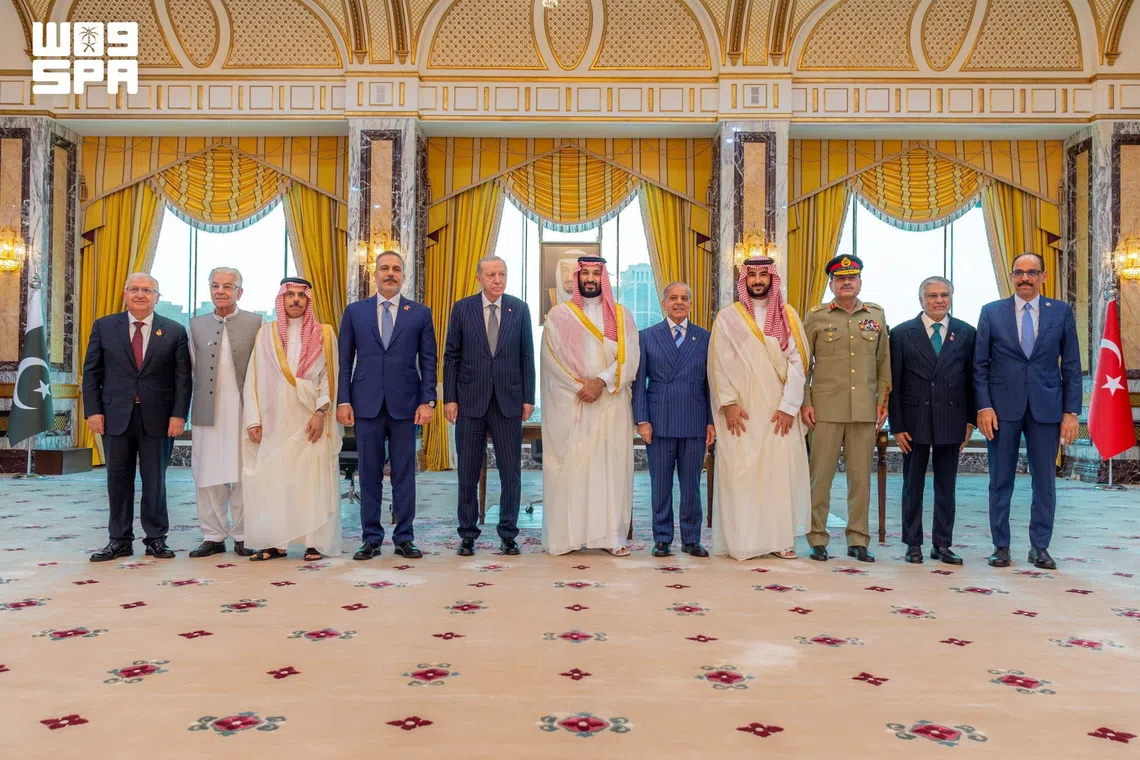
- Turkiye, Saudi Arabia, and Pakistan signed the Mecca Joint Defence Agreement on Friday, with Erdogan, Crown Prince Mohammed bin Salman, and Prime Minister Shehbaz Sharif declaring that an armed attack on one would be treated as an attack on all three.
- Turkish Foreign Minister Hakan Fidan told Anadolu on Saturday that the pact does not identify Iran or any other country as a common threat: "There is no common threat that we have put in writing," adding that non-signatory states are not targets.
- The agreement includes a NATO Article 5-style clause, but Fidan said responses would be case-by-case — the attacked country would request specific support, ranging from intelligence and logistics to ammunition or troop deployment.
- Iranian officials publicly pushed back: parliamentary National Security Commission member Mahmoud Nabavian warned Saudi Arabia that cooperation with Turkiye and Pakistan would not guarantee its security, while fellow member Ebrahim Rezaei called the pact a "paper agreement."
- Iran's Foreign Minister Abbas Araghchi posted on X on Friday calling on regional states to rely on themselves and pursue "true brotherhood," while stressing the strength and readiness of Iran's armed forces.
- The pact goes beyond a declaration: a permanent secretariat will sit in Saudi Arabia, alongside political and military committees, joint training, intelligence sharing, threat assessments, and notably defence-industry cooperation — one of the main issues discussed in Mecca.
- Fidan said preparations took nearly two years and eight months, predating current Iran tensions, and named Egypt — described as a "natural partner" — as likely to join once outstanding technical issues are resolved.
- Cross-coverage note: India Today's headline frames the pact around unity among the three signatories, while the dominant angle emphasizes the non-Iran framing — but the source text itself gives more space to Iran's vocal skepticism than to Ankara's reassurance, and the 32-month preparation timeline plus Egypt queue suggests a real military bloc rather than a symbolic gesture.
Why it matters: After nearly 32 months of preparation, the three countries built more than a declaration — a permanent secretariat in Riyadh, joint training, and defence-industry cooperation — with Egypt likely to join next, formalizing a Muslim-majority mutual-defence bloc that operates outside US and NATO structures and directly answers Fidan's critique that "external hegemons" worsen regional problems.
Ask SkimNews