China's 1.4B-Barrel Oil Stockpile Beats Iran War Shock — SkimNews

Get the Geopolitics newsletter
Daily geopolitics — wars, elections, sanctions, the diplomatic moves that move markets. Free.
- China held an estimated 1.397 billion barrels of strategic crude oil reserves as of December 2025, roughly 3.4 times the U.S. stockpile of 413 million barrels and nearly five times Japan's 263 million, according to U.S. Energy Information Administration data.
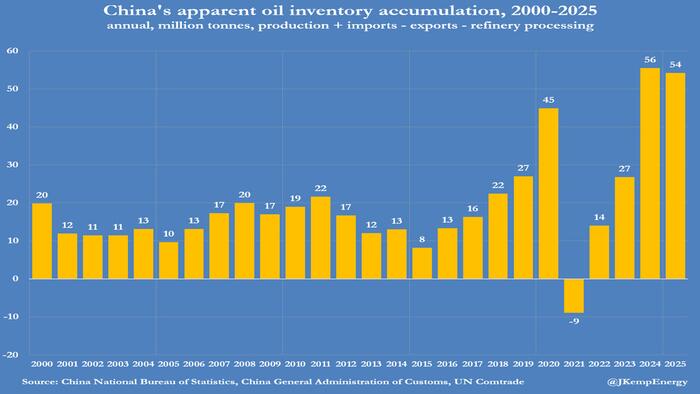
- China added an average of 1.1 million barrels per day to its strategic inventories throughout 2025, driven by relatively low oil prices, sanctions-driven supply disruption risks from major suppliers (Russia, Venezuela, Iran), and a new domestic energy law requiring companies to hold more reserves.
- China continued building crude inventories into early 2026 before the Iran conflict began in late February, according to preliminary government data cited by Axios.
- The International Energy Agency coordinated the largest-ever emergency release of oil reserves on March 11, making up to 400 million barrels available—but China, which is not an IEA member, was not part of that release.
- The U.S. Strategic Petroleum Reserve stood at roughly 409 million barrels after the March release, still well below its 714-million-barrel capacity following a record 2022 drawdown tied to Russia's invasion of Ukraine, and unlikely to be refilled cheaply while the Iran war continues.
- Axios CEO Jim VandeHei wrote that "the war was the stress test that Beijing's energy strategy was designed for," noting that China also controls over 70% of global solar, wind, battery, and EV supply chains—an additional lever as import-dependent nations pivot toward renewables.
- EIA noted that China does not publish oil inventory data, forcing U.S. analysts to estimate the stockpile from trade flows, refining data, and third-party and official Chinese sources.
Why it matters: China's 1.4-billion-barrel cushion—built methodically while oil was cheap—now insulates its economy from the Strait of Hormuz closure while the U.S. Strategic Petroleum Reserve sits at roughly 57% capacity and the rest of the world scrambles. That asymmetry turns an energy shock into a geopolitical windfall for Beijing, reinforced by its grip on 70%+ of clean-energy supply chains that import-dependent countries are now scrambling to secure.
Ask SkimNews