UC Berkeley Maps Sleep-Growth Hormone Feedback Loop — SkimNews
Get the Health newsletter
Daily health & science — research, biotech, public health, the studies worth knowing. Free.
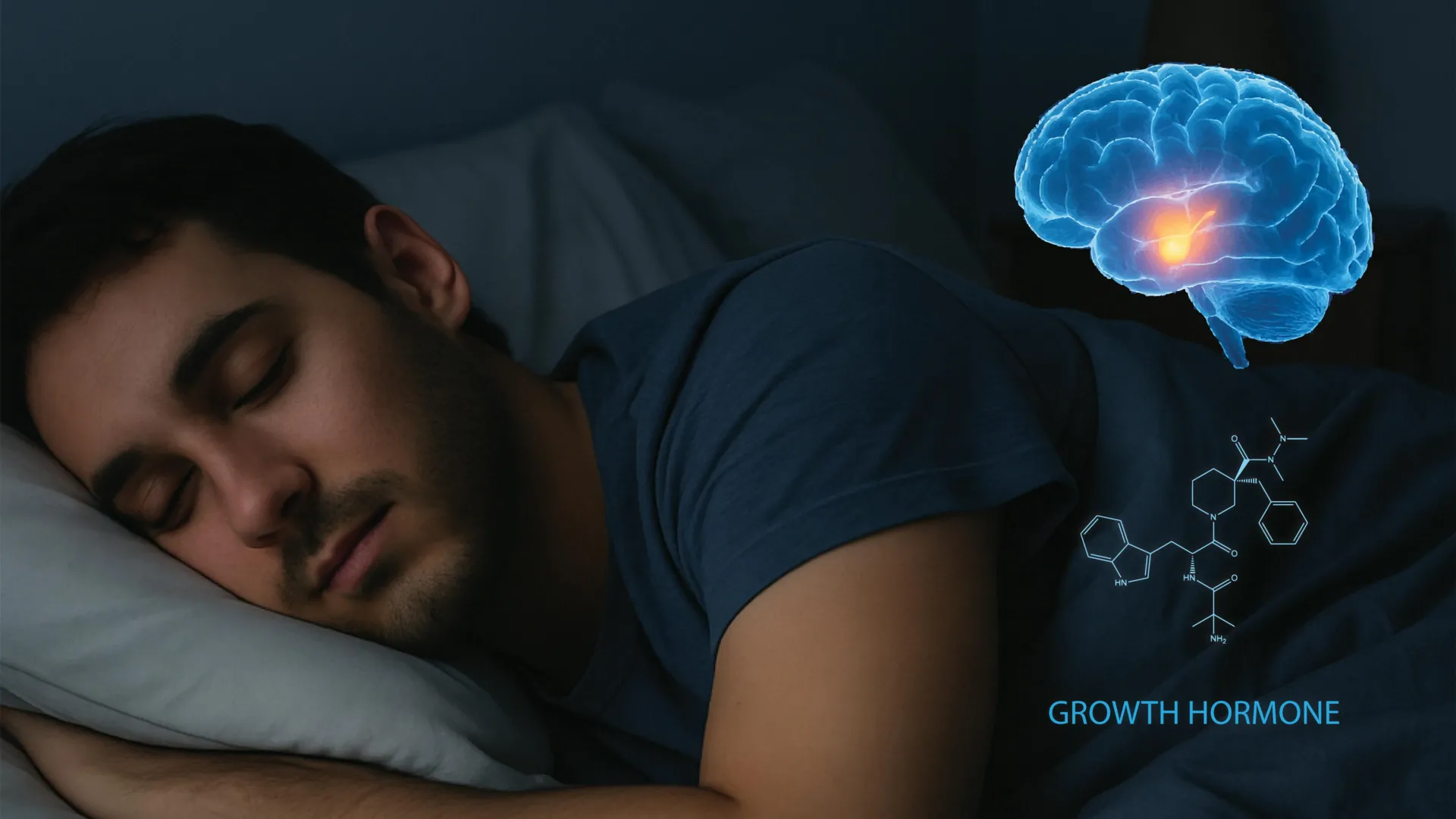
- UC Berkeley researchers identified neurons in the hypothalamus that control growth hormone release during sleep, publishing the work in the journal Cell and uncovering a previously unknown two-way relationship between sleep and the hormone.
- The team, working in Yang Dan's neuroscience lab, used implanted electrodes and light-based neuron stimulation in mice to directly record neural activity during sleep–wake transitions—the first study to do so rather than measuring hormone levels in blood.
- Growth hormone feeds back on the locus coeruleus, the brainstem region governing alertness and attention, gradually promoting the transition to waking as the hormone accumulates during sleep.
- GHRH (which stimulates growth hormone) and somatostatin (which suppresses it) operate differently across sleep stages—rising together during REM sleep, while somatostatin drops and GHRH rises moderately during non-REM sleep, with both patterns promoting hormone release.
- Co-author Daniel Silverman noted that overstimulating the locus coeruleus can paradoxically produce sleepiness rather than wakefulness—work published earlier in 2026—creating a homeostatic system that balances hormone levels with the sleep–wake cycle.
- First author Xinlu Ding said the circuit offers a novel handle for experimental gene therapies that target specific cell types, though results are in mice and human translation remains unproven.
Why it matters: By pinpointing the specific neurons and feedback loop linking deep sleep, growth hormone, and wakefulness, the Berkeley team gives drug developers a concrete neural target—the locus coeruleus—for the first pathway-specific treatments aimed at sleep disorders connected to diabetes, Parkinson's, and Alzheimer's.
Ask SkimNews