Chinese Warship Holds Live-Fire Drill in Japan's EEZ

Get the Geopolitics newsletter
Daily geopolitics — wars, elections, sanctions, the diplomatic moves that move markets. Free.
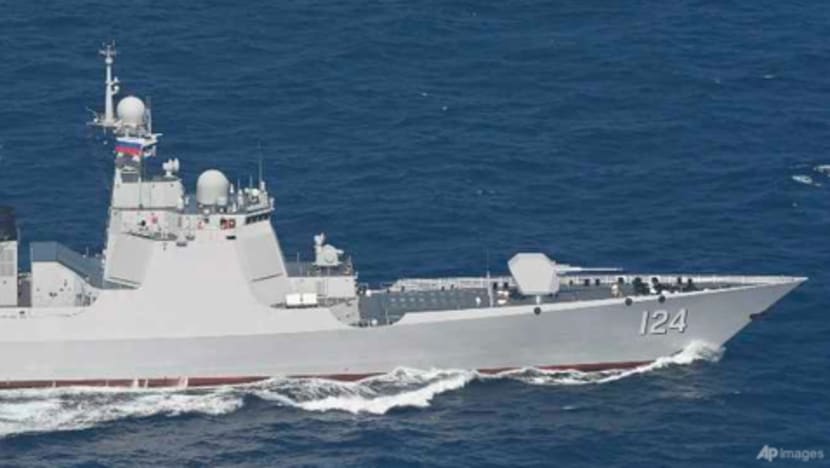
- China's Luyang III-class destroyer conducted a live-fire exercise about 180 km southwest of Okinotori Island early on July 19, operating alongside Russian naval vessels, per Japan's Joint Staff — the first time Japan has disclosed China's live-fire drills inside its EEZ.
- Japan's Maritime Self-Defense Force spotted four vessels sailing northeast roughly 330 km southwest of Okinotori at around 2 a.m. on July 19: a Chinese Renhai-class guided-missile destroyer, a Luyang III-class destroyer, a Fuchi-class replenishment ship, and a Russian Steregushchiy-class frigate.
- A Joint Staff spokesperson stressed the activity was "not against international rules," even as Japan formally flagged it as a first-of-its-kind EEZ live-fire incident.
- The same four-vessel group had transited southward through waters between Okinawa's main island and Miyako Island on July 16, pointing to a coordinated patrol circuit.
- Japan's Defense Ministry dispatched a destroyer to monitor the ships and gather intelligence on their activities throughout the encounter.
- China disputes Japan's claim that waters around Okinotori are part of its EEZ, insisting the feature is a reef rather than an island — a classification fight that could shrink Tokyo's claimed maritime zone if resolved in Beijing's favor.
- China and Russia have stepped up joint naval and air operations around Japan in recent years, prompting Tokyo to expand surveillance and harden defenses across its southwest island chain.
Why it matters: Japan flagged the July 19 drill as a first-of-its-kind disclosure while explicitly saying the activity broke no international rules — meaning Tokyo's concern is precedent, not legality. With China contesting whether Okinotori counts as an island or a reef, normalized live-fire exercises could harden Beijing's position and accelerate Japan's southwest island-chain surveillance build-up, now backed by a Russian frigate signaling this is a two-power operation, not a solo provocation.