Both Koreas Build Armed Drones, Learning From Ukraine — SkimNews

Get the Geopolitics newsletter
Daily geopolitics — wars, elections, sanctions, the diplomatic moves that move markets. Free.
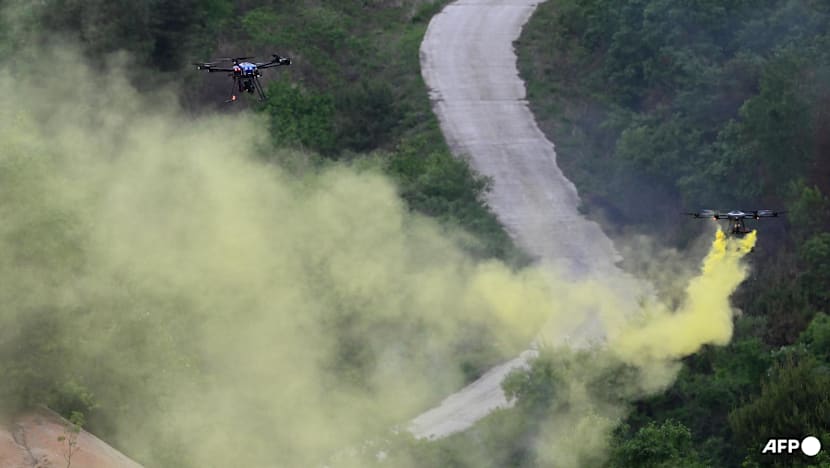
- Both Koreas are developing low-cost, long-range armed attack drones, catalyzed by the wars in Ukraine and Iran, with some systems slated to be operational in the near term and integrated into deep-strike strategies alongside ballistic and cruise missiles.
- Kim Jong Un ordered officials in 2024 to "establish a mass-production system and begin full-scale operation" of suicide attack drones, and thousands of North Korean laborers — possibly including engineers — have been sent to Russia's Yelabuga factory producing copies of Iran's Shahed one-way attack drone.
- South Korea's Agency for Defense Development is developing the KUS-LM, dubbed "K-LUCAS," a one-way attack drone with range and payload figures comparable to the American LUCAS, with deployment planned before 2030 and trials already underway on land and sea.
- North Korea unveiled high-altitude and medium-altitude long-endurance reconnaissance drones in 2023 — the MALE variant is capable of firing a missile — though limited numbers are currently in the inventory.
- South Korea's Three Axis non-nuclear deterrent — Kill Chain preemptive strikes, Korea Air and Missile Defense, and Korea Massive Punishment and Retaliation — depends on near-perfect, near-persistent intelligence over North Korea, but its in-development space-based ISR layer leaves roughly 2-hour observation windows over potential launch sites.
- The Drone Operations Command, established in September 2023 under the Yoon administration with an explicit offensive drone mission, was disestablished after Yoon's 2024 self-coup attempt; the mission continues under the new Defense Drone headquarters, which focuses on force development while shedding any operational role to the services.
Why it matters: The Lee administration's push to assume wartime operational control from the United States now collides directly with South Korea's unresolved ISR gap: even with new satellites and drones expected online within five years, mobile North Korean launchers will remain difficult to find and track, and roughly 2-hour observation windows over launch sites leave the Three Axis strategy's preemptive-strike logic under-resourced. The capability mismatch widens as North Korea pairs cheap Shahed-copy drone salvos with a growing nuclear-missile arsenal, potentially forcing Seoul to either delay OPCON transfer or accept greater alliance dependence on US intelligence assets.
Ask SkimNews