David Hockney Remembered as Pop Art's Unabashed — SkimNews

Get the Culture newsletter
Daily culture — film, music, books, the trends and ideas worth your attention. Free.
- Portrait of an Artist (Pool with Two Figures) (1972), painted as Hockney's relationship with Peter Schlesinger ended, sold in 2018 for $90.3m — then a record for a living artist
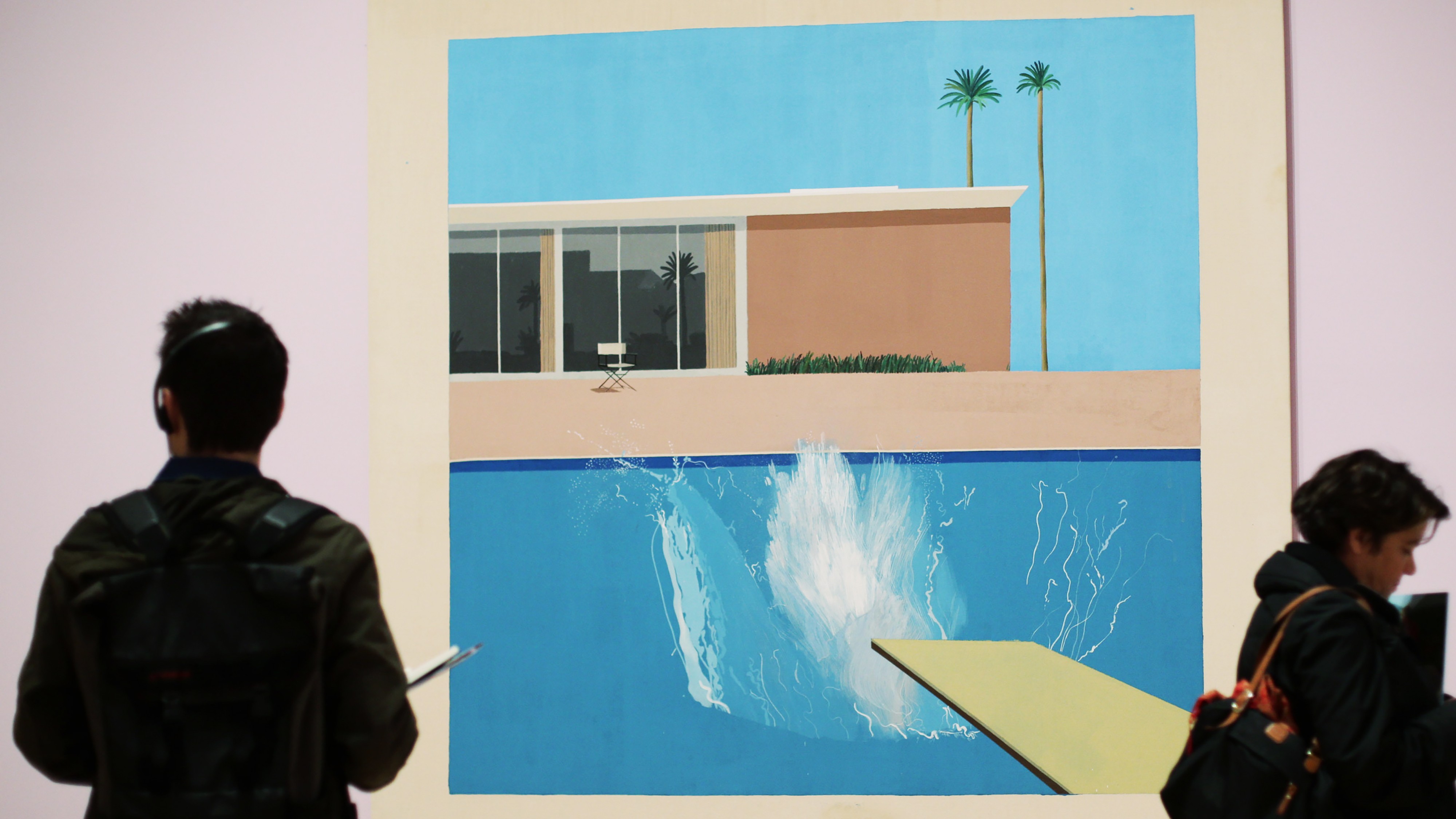
- A Bigger Splash is positioned as the 1960s answer to Matisse's 1904 hedonist manifesto Luxe, Calme et Volupté, and Hockney himself as 'the Matisse of pop art'
- Doll Boy (1960-1) confessed Hockney's passion for Cliff Richard ('very attractive, very sexy'), while his composed 1968 portrait depicted Christopher Isherwood and Don Bachardy as a confident gay couple — part of his relaxed, untroubled depiction of a sexuality that was then illegal in Britain
- Hockney's 1961 US trip inspired prints modeled on William Hogarth's The Rake's Progress, in which a bespectacled, weedy Hockney discovers America's gay scene and ends up surrounded by 'jeans-wearing clones listening to pop music on earphones'
- His photo collages applied cubism's shifting, multi-perspectival viewpoints to photography in some of his most instantly recognisable works
- Hockney argued Caravaggio used an early camera, demonstrating the theory during a National Gallery visit where he also unfurled a Japanese scroll to show how eastern landscape art embraces the world's scale through shifting viewpoints rather than single-point perspective
- Hockney's celebrity is compared to the Beatles, David Attenborough, and the Queen — a popularity that has eluded younger British artists, underpinned by a 'modesty and directness' that made him a 'courteous libertarian'
Why it matters: Hockney's death removes the rare British artist who achieved genuine popular celebrity — a status the piece compares to David Attenborough's — and pop art's only un-ironic celebrant of modern life, distinct from critics like Warhol and Richter. The $90.3m 2018 sale of *Portrait of an Artist* underscores his commercial and historical weight, while his Bradford-to-Bridlington arc and refusal of nostalgia gave post-war British art a figure who treated ordinary life, including his own homosexuality, as simply true.
Ask SkimNews