Bitcoin retreats from one-month high as oil tops $85, inflation concerns resurface — SkimNews
Get the Finance newsletter
Daily finance — markets, central banks, M&A, the prints that move money. Free.
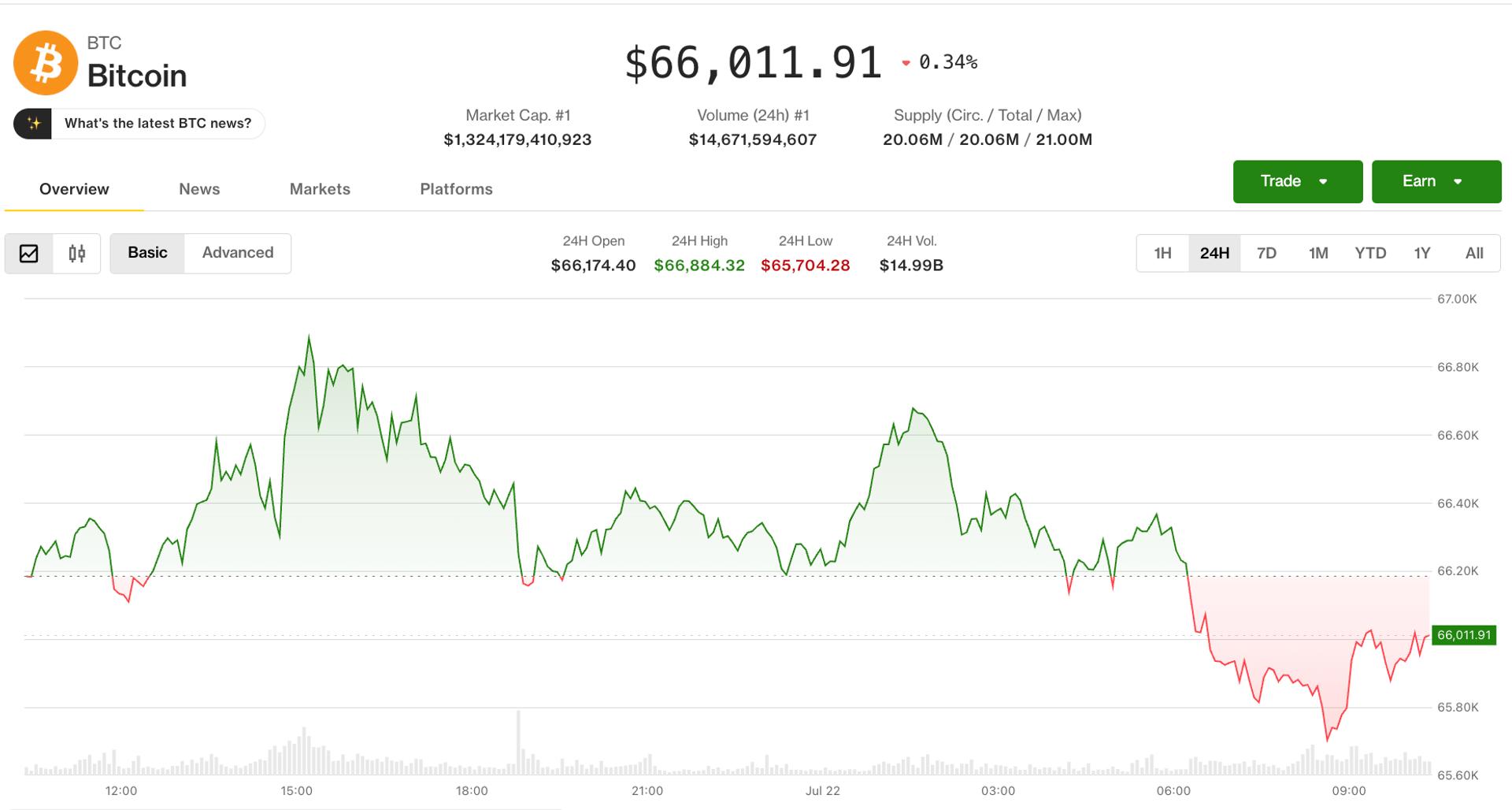
- Bitcoin fell below $66,000 to roughly $65,900 after reaching a one-month high on Tuesday, retreating as WTI crude topped $85/barrel for the first time since June 12 amid the escalating Iran conflict that reignited inflation concerns.
- WTI crude's surge past $85/barrel pushed investors into haven assets, with gold climbing 0.95% to $4,118 and silver gaining 1.2%, while Nasdaq 100 and S&P 500 futures fell.
- Bitcoin's dominance climbed to 59% as capital rotated from altcoins and stablecoins into BTC, reflecting a risk-off rotation playing out inside crypto.
- Bitcoin derivatives signaled indecision: 24-hour trading volume dropped 12% to $150 billion while open interest held steady at $116 billion and the long/short ratio tightened to 50.59/49.41.
- Hyperliquid's HYPE token fell over 6% as futures open interest surged to 42.8 million tokens — the highest since June 4 — with negative funding rates and red cumulative volume delta pointing to aggressive short positioning.
- Bitcoin's 30-day implied volatility (BVIV) rose to 40% from 37.5%, even as BTC calls dominated Deribit's 24-hour volume with activity concentrated at the $70,000 and $72,000 strikes, suggesting some traders are positioning for upside past the current decline.
- Ondo (ONDO) rose 26% over seven days to $0.40 on tokenized real-world asset demand, while Midnight (NIGHT) surged 19% after Cardano founder Charles Hoskinson praised the project on X.
Why it matters: WTI crude topping $85 for the first time since June 12 directly undercuts the soft-inflation thesis supporting risk assets. Bitcoin's jump to 59% dominance and rising implied volatility (40% from 37.5%) show traders hedging within crypto, while $70,000–$72,000 call concentration on Deribit hints that some see the pullback as a dip-buying setup rather than a trend reversal.
Ask SkimNews