US Drone Supply Chain Mapped: 8 Parts, 4 Cert Lists — SkimNews
Get the Geopolitics newsletter
Daily geopolitics — wars, elections, sanctions, the diplomatic moves that move markets. Free.
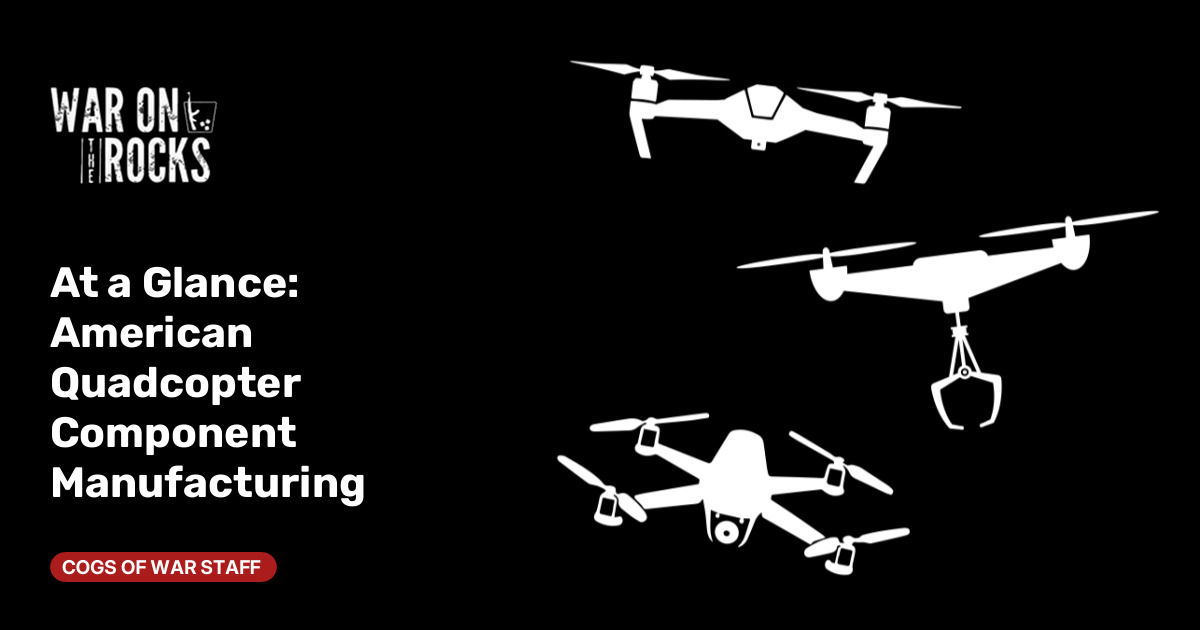
- War on the Rocks broke military quadcopters into eight component categories — airframe, datalink, payload, flight stack, battery, camera, rotors and motors, and navigation systems — each card highlighting representative U.S.-domiciled manufacturers with large Defense Department contracts.
- The Wall Street Journal sparked the underlying debate last month with a visual analysis emphasizing China's manufacturing and cost advantages in military quadcopter components, prompting the Defense Innovation Unit director to object on X that the piece 'leaves out' dozens of U.S. drone-component companies.
- The Defense Contract Management Agency's "Blue List" covers 67 whole, ready-to-fly drones with verified supply-chain security, while the Blue UAS Framework catalogs 135 companies selling individual or modular drone parts with government-approved supply chains.
- National Defense Authorization Act compliance frameworks allow companies to self-report as approved suppliers, and third-party evaluators like the Association for Uncrewed Vehicle Systems International run a "Green List" working with the Defense Innovation Unit to certify NDAA compliance.
- War on the Rocks excluded non-U.S.-domiciled companies from its manufacturer tally and notes that per-category totals are approximate because compliance is self-reported and the market is changing quickly with new entrants and acquisitions.
- The authors conclude that the U.S. drone-component ecosystem is broader than some readers realize, but the certification system is uneven and difficult to measure.
Why it matters: With only 67 Blue-List drones and a 135-company Blue UAS catalog sitting alongside self-reported NDAA compliance, the Pentagon's decoupling strategy runs into a measurement gap: hundreds of domestic suppliers exist across the eight component categories, but verification is uneven, making it hard for defense planners to gauge actual exposure to Chinese parts.
Ask SkimNews