Hidden Stripe Map in Nose Reveals Smell's Organization — SkimNews
Get the Health newsletter
Daily health & science — research, biotech, public health, the studies worth knowing. Free.
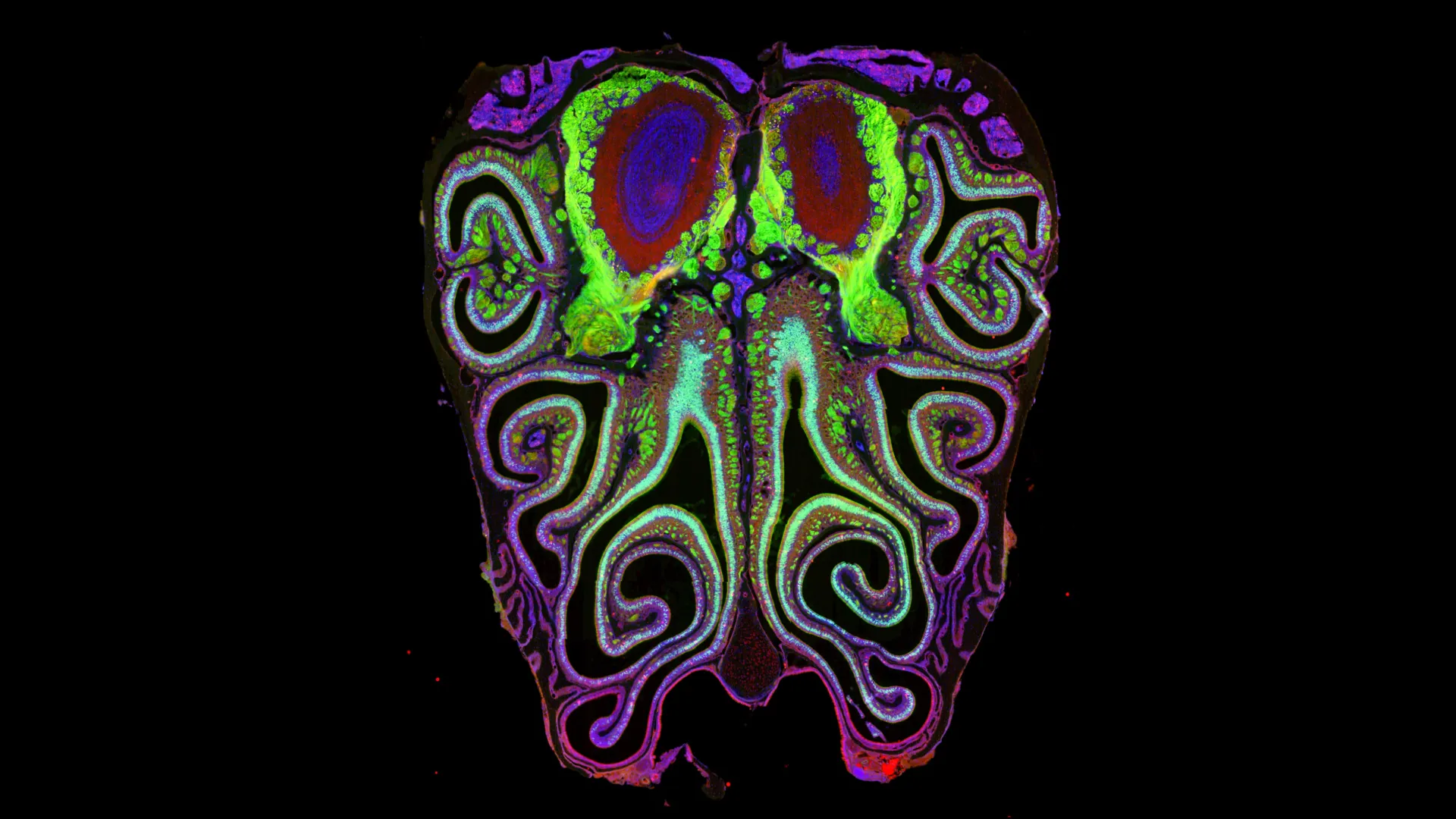
- Sandeep Robert Datta's team analyzed roughly 5.5 million neurons across more than 300 mice, discovering that smell receptors form tight, overlapping horizontal stripes grouped by receptor type — overturning the long-held view that their placement was random.
- The nasal stripe pattern closely mirrors the map of smell information in the brain's olfactory bulb, revealing a coordinated system that links nose to neural circuit.
- Retinoic acid, a gene-regulating molecule, forms a gradient in the nose that guides each neuron to activate the correct receptor based on its position; experimentally shifting retinoic acid levels moved the entire receptor map upward or downward.
- The study published April 28, 2026 in Cell was accompanied by a separate, consistent study from Catherine Dulac's lab at Harvard University in the same issue, providing independent confirmation.
- Mice carry ~20 million olfactory neurons expressing more than 1,000 receptor types — compared to just three for human color vision — a complexity that helps explain why mapping smell has lagged behind vision, hearing, and touch.
- The discovery lays groundwork for treating smell loss, which currently has few effective options despite affecting safety, nutrition, and mental health; Datta's team is exploring stem cell therapies and brain-computer interfaces.
Why it matters: Olfaction was the only major sense without a known spatial organization map, a gap that has blocked progress on treating smell loss. By revealing both the stripe layout in the nose and the developmental mechanism (retinoic acid) that builds it, the study gives researchers a concrete target for therapies — including stem cell approaches and brain-computer interfaces — aimed at restoring a sense that currently has few effective treatments.
Ask SkimNews