Cornex launches 165 Ah sodium-ion cell for stationary storage — SkimNews
Get the Energy newsletter
Daily energy & climate — solar, EVs, oil, the policy fights and tech bets shaping the transition. Free.
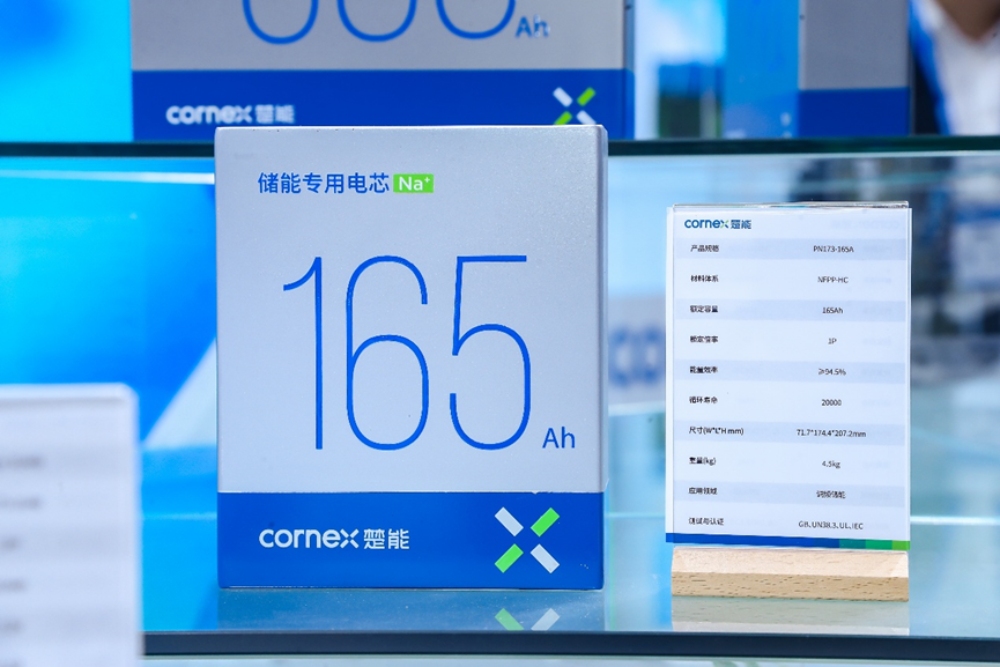
- Cornex New Energy added 165 Ah and 58 Ah sodium-ion prismatic cells to its product lineup for stationary energy storage, with the 165 Ah model designated PN173-165A.
- The 165 Ah cell uses sodium iron pyrophosphate in the cathode and polyanion-type NFPP hard carbon as the anode, and has secured GB Chinese national standard, UN38.3, UL, and IEC 62619 certifications.
- Cornex claims the cell delivers 94.5% 1P energy efficiency and a cycle life exceeding 20,000 cycles, positioning it as "ideal for frequency regulation."
- The cell measures 71.7 mm x 174.4 mm x 207.2 mm, weighs 4.5 kg, and achieves nominal energy density of 102 Wh/kg gravimetric and 182 Wh/L volumetric at 0.5P.
- Compared to Cornex's own 314 Ah LFP cell (5.6 kg), the sodium-ion cell is 24% lighter but stores roughly half the energy — about 48% less — illustrating sodium-ion's persistent energy density disadvantage.
Why it matters: For large-scale stationary storage buyers, Cornex's 165 Ah sodium-ion cell brings a certified, cycle-hardy alternative to LFP, with 20,000+ cycles and 94.5% efficiency that suit frequency regulation duty cycles. The trade-off remains density: the cell is 24% lighter than Cornex's comparable LFP but delivers only about 52% of the energy, meaning larger battery rooms for the same capacity — a cost question sodium-ion's raw-material edge must answer.
Ask SkimNews