SOC Design Should Mirror Kahneman's Dual Systems
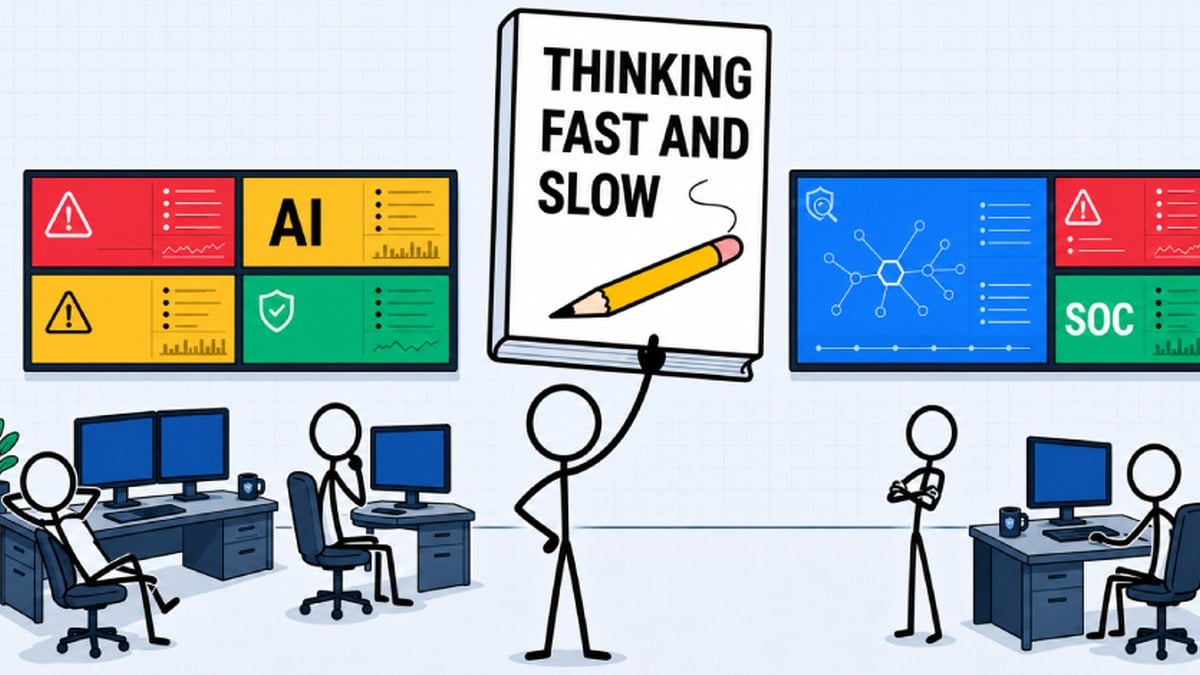
The 30-Second Skim
- What happened: A security-industry essay argues SOCs should mirror Kahneman's dual-process model: autonomous AI to triage 98% of alerts at machine speed, and analyst copilots like Claude reserved for the 2% requiring genuine human judgment.
- Key facts & numbers: Research on more than 25 million enterprise alerts found 98% can be resolved autonomously while only ~2% warrant human review — a ratio the author notes is almost identical to Kahneman's 95%/5% System 1/System 2 split. An enterprise receiving 450,000 alerts per year can expect roughly 54 real threats hidden in low-severity alerts that never make it to an analyst's queue because triage capacity runs out. Autonomous SOC AI investigates 100% of signals continuously, reaches verdicts at 98% accuracy in under two minutes, and hands human teams only the 2% of cases that warrant attention, with all evidence pre-assembled.
- What happens next: The 95/5 cognitive split maps almost perfectly to a 98/2 SOC alert split — buried kicker: 54 real threats/year hide in your noise pile.
- Research on more than 25 million enterprise alerts found 98% can be resolved autonomously while only ~2% warrant human review — a ratio the author notes is almost identical to Kahneman's 95%/5% System 1/System 2 split.
- An enterprise receiving 450,000 alerts per year can expect roughly 54 real threats hidden in low-severity alerts that never make it to an analyst's queue because triage capacity runs out.
- Autonomous SOC AI investigates 100% of signals continuously, reaches verdicts at 98% accuracy in under two minutes, and hands human teams only the 2% of cases that warrant attention, with all evidence pre-assembled.
- Frontier AI platforms like Claude, Codex, and Cursor belong in the "slow brain" role — complex case analysis, detection rule engineering, threat hunting — but should receive fully investigated cases, not raw alerts, the author argues.
Why It Matters
Security teams are running both failure modes simultaneously — burning human analysts on System 1 triage work and deploying expensive frontier models directly against raw alert streams. The essay argues that owning investigation in-house, rather than outsourcing to MDRs, is now the prerequisite for making AI copilots useful, since the institutional knowledge that makes the slow brain smarter only accumulates inside the enterprise's own instance.
Sources Cited
Related Coverage
Ask SkimNews