Building an Arsenal That Survives the Tenth Salvo — SkimNews
Get the Geopolitics newsletter
Daily geopolitics — wars, elections, sanctions, the diplomatic moves that move markets. Free.
- The author argues the US defense industrial base cannot keep pace with munitions expenditure, with manufacturing lead times for critical weapons running 2-4 years even with expanded orders, new suppliers, and new plants.
- Adm. Sam Paparo, commander of U.S. Pacific Command, told the Senate last year: "You can't AI your way out of material deficiency," underscoring that the shortfall is industrial, not algorithmic.
- Ukraine and Iran are cited as proof that massive munitions plants and single-source suppliers represent a focused target list for adversaries with deep-strike capabilities.
- Russia demonstrates weapons iteration cycles of days or weeks through component swaps on unchanged airframes, though the article notes hard-tooling changes — like swapping warheads or propulsion — significantly extend that cycle.
- GE Aerospace consolidated 855 conventionally manufactured parts into 12 additive components in its FAA-certified Catalyst turboprop, while General Atomics achieved over 95% part consolidation on a small UAS aerostructure with tool-less robotic assembly in under 20 minutes.
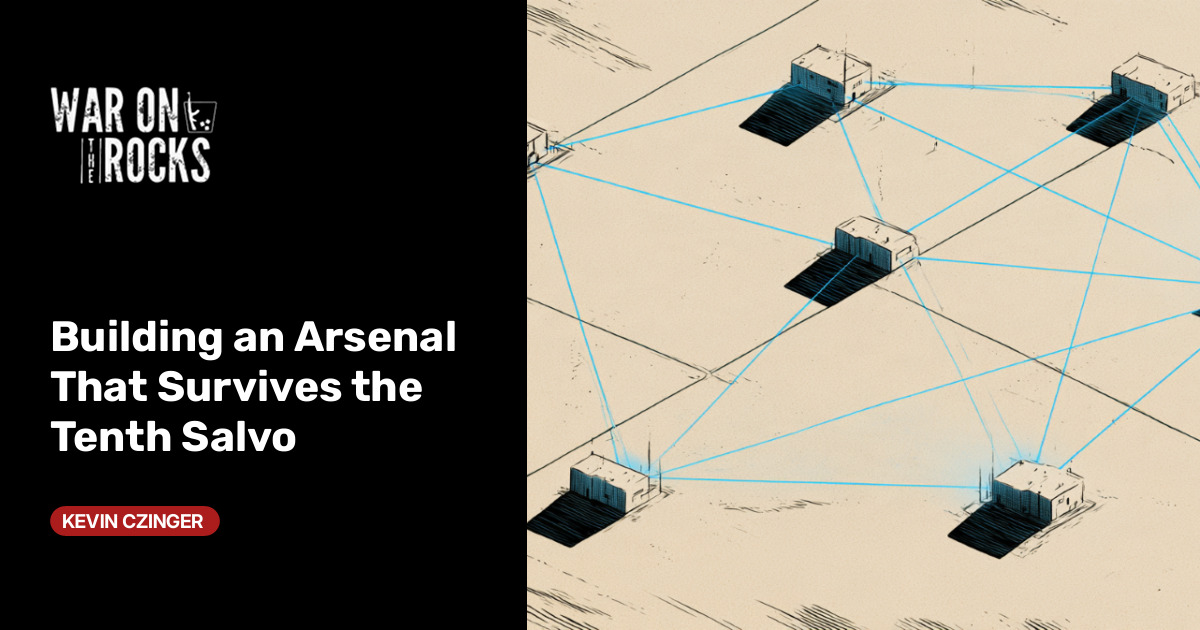
- The proposed network centers on a government-owned standard, process-level certification that travels with the design file, design-agnostic factory equipment, and dual-use peacetime capacity that converts to wartime surge — modeled on the semiconductor industry.
- The author discloses a direct commercial interest as founder of a company operating such factories, but argues the government should own the standard and ensure no single company is the sole provider.
Why it matters: The analysis reframes munitions production as an industrial bottleneck requiring 2-4 year lead times to be compressed into weeks — a gap only a government-owned, software-defined factory network can close, per the author. If implemented, the model would let the Pentagon iterate weapons in days and regenerate capacity even after nodes are struck, directly addressing the depletion timelines already visible in Ukraine and against any peer adversary in the Pacific.
Ask SkimNews


