Hockney's 'Contrejour' Captures Style He Was About to Break — SkimNews
Get the Culture newsletter
Daily culture — film, music, books, the trends and ideas worth your attention. Free.
- David Hockney, who died at 88 in June, became famous for bringing 20th-century subjects into the formal, symmetrical compositions of early Renaissance painting.
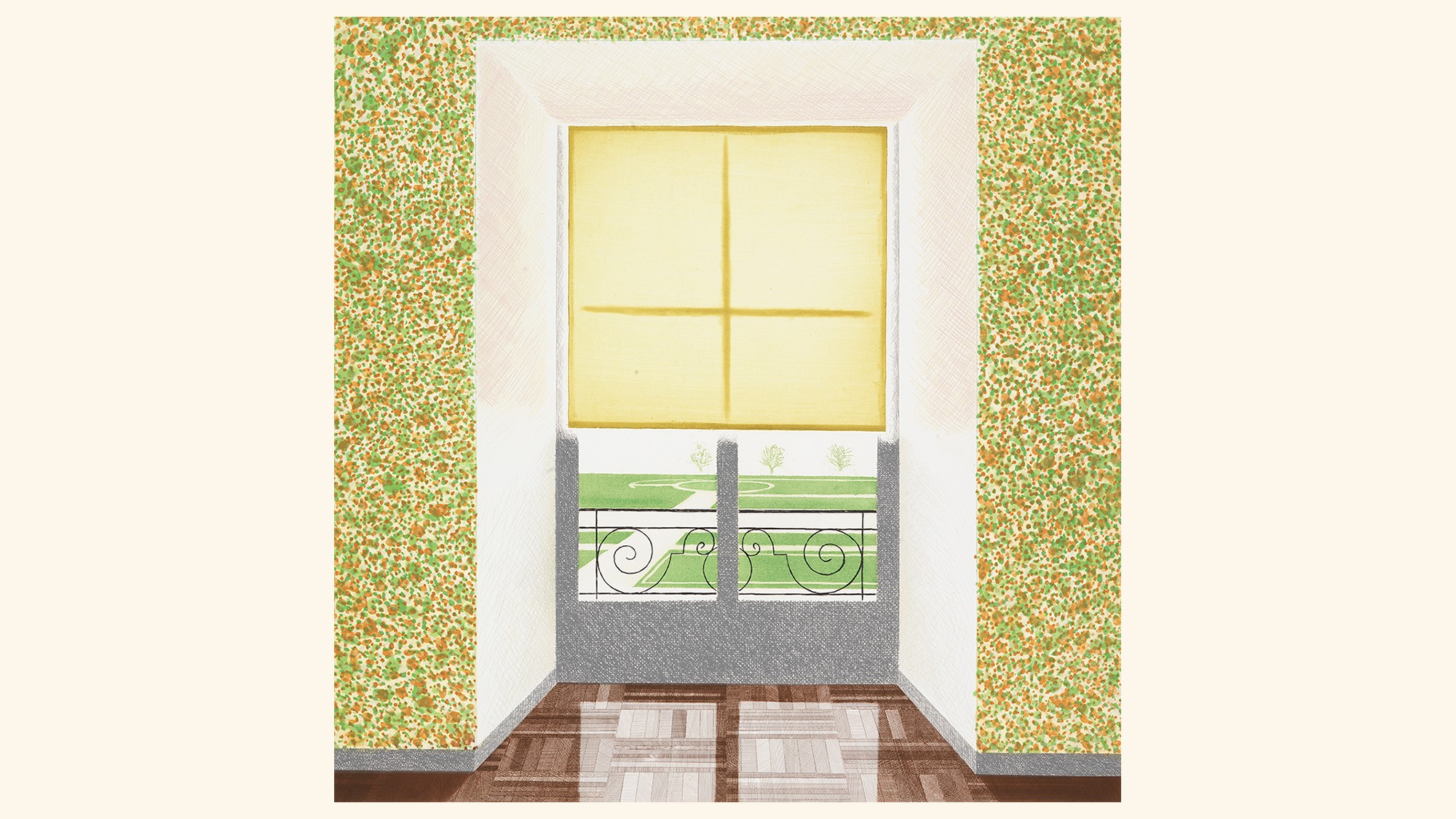
- "Contrejour in the French Style" depicts a Louvre window that Hockney encountered shortly after moving to Paris in 1973, when he called it "a picture in itself."
- Hockney rebuilt the found scene from a drawing and photographs, streamlining the parterres to echo the nearby Tuileries and rendering the balustrade as a "compass-and-protractor enactment" of the original.
- The artist used distinct etching techniques for different zones: soft mats of color for the window blind, meticulous linear hatching for the floor, and splotchy translucent color for the surrounding wall.
- The dappled wall nods to Georges Seurat's pointillism, while the formal garden, parquet, and deep window setback together evoke the French classical tradition of beauty-by-rule.
- Soon after this print, Hockney's style shifted toward fragmented space, expressive brushwork, and episodic motion—dismantling the very pictorial machinery the print still wields.
- The piece appears in the September 2026 print edition under the headline "Contrejour in the French Style."
Why it matters: For art historians and readers engaging with Hockney's legacy following his June death, this print marks a precise threshold in his career—a moment when his classical-French formalism was still intact but about to give way to the fragmented, expressionist style he would pursue in subsequent decades. Its position immediately before that pivot makes it a key reference point for tracing the artist's evolution.
Ask SkimNews