Saudi Arabia, Turkey, Pakistan Sign Mecca Defense Alliance — SkimNews

Get the Geopolitics newsletter
Daily geopolitics — wars, elections, sanctions, the diplomatic moves that move markets. Free.
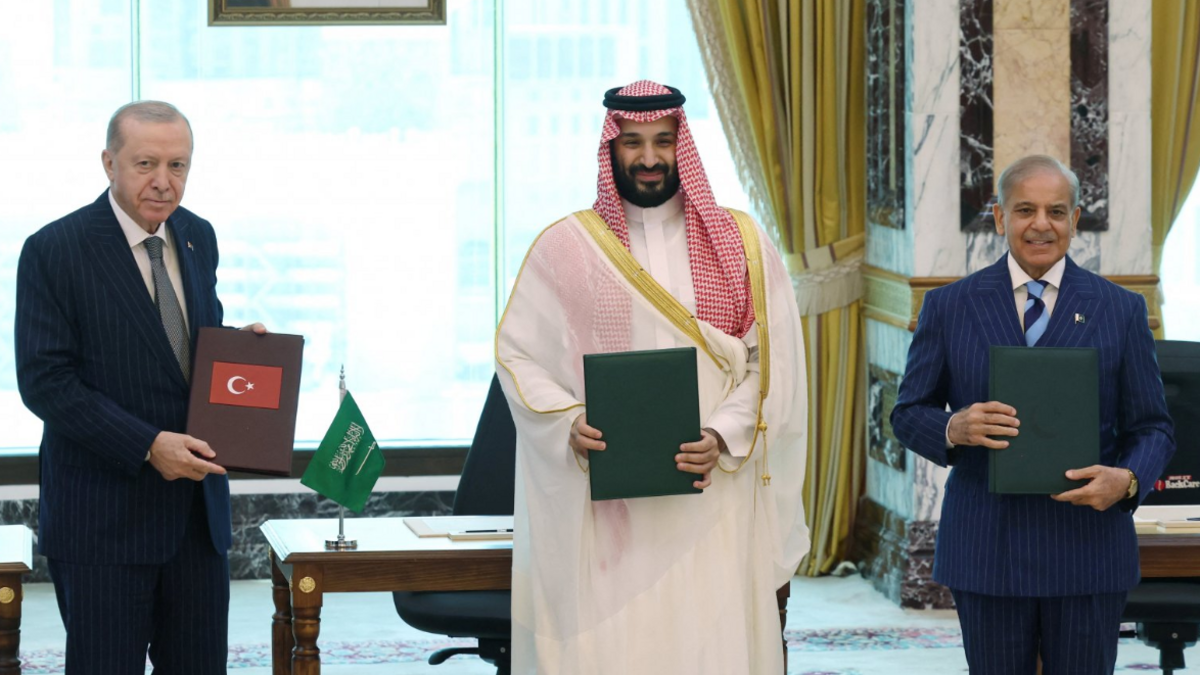
- Saudi Arabia, Turkey, and Pakistan signed the Mecca Joint Defense Agreement on Friday in Riyadh, with Crown Prince Mohammed bin Salman, President Recep Erdogan, and PM Shehbaz Sharif pledging that "any armed attack against any one of the three states shall be regarded as an attack against them all."
- The alliance emerged after Iran bombed US-allied Gulf territory and Washington withdrew hundreds of military personnel from Gulf bases—Harvard economist Ken Rogoff noted Gulf states are now asking: "We thought you built those bases to protect us."
- Turkish foreign policy expert Ozgur Unluhisarcikli told Al Jazeera the pact is not a ready-for-action mutual defense treaty but a modest "framework for closer strategic, military, and defense-industrial coordination."
- Pakistan contributes a nuclear arsenal; Turkey brings NATO's second-largest army and is constructing a missile base in Somalia with rockets reaching 1,250 miles—covering the Arabian Peninsula, Red Sea shipping lanes, and the Strait of Hormuz.
- Iran's Foreign Minister Abbas Araghchi dismissed the pact as misguided and boasted of Iranian forces fighting off "the world's most expensive military," while MP Ebrahim Rezaei warned Saudis that "a paper agreement with Turkey and Pakistan will not bring them security."
- Turkey's regional ambitions increasingly collide with Israel's "Pax Israeliana" push across the Middle East, with analysts at the Jazeera Center for Studies writing that Israeli military moves "have direct consequences for Turkish security and economic interests."
- Saudi Arabia's pivot predates this pact: in 2023 it restored ties with Iran via China-brokered talks in Beijing, and during Trump's first term grew disillusioned after he failed to retaliate for Iranian drone and tanker attacks on Saudi oil infrastructure in 2019.
Why it matters: All three signatories still depend on US armaments—a dependency the article notes "can't evaporate overnight"—meaning the pact is more geopolitical signal than operational military alliance. Turkey emerges as the clearest strategic winner, with its Somalia-based 1,250-mile missile range now reaching the Strait of Hormuz and Red Sea, giving Ankara leverage against Israel's regional designs and a seat at a Gulf security table Washington has dominated since 1990.
Ask SkimNews