Closing Eyes Impairs Hearing in Noise, Study Finds — SkimNews
Get the Health newsletter
Daily health & science — research, biotech, public health, the studies worth knowing. Free.
- Shanghai Jiao Tong University researchers found that closing one's eyes impairs the ability to detect faint sounds in noisy settings, with author Yu Huang stating the result runs 'contrary to popular belief.'
- Yu Huang and colleagues published their findings in the Journal of the Acoustical Society of America (JASA), via AIP Publishing, showing that watching a dynamic video matching the sound significantly improved hearing sensitivity.
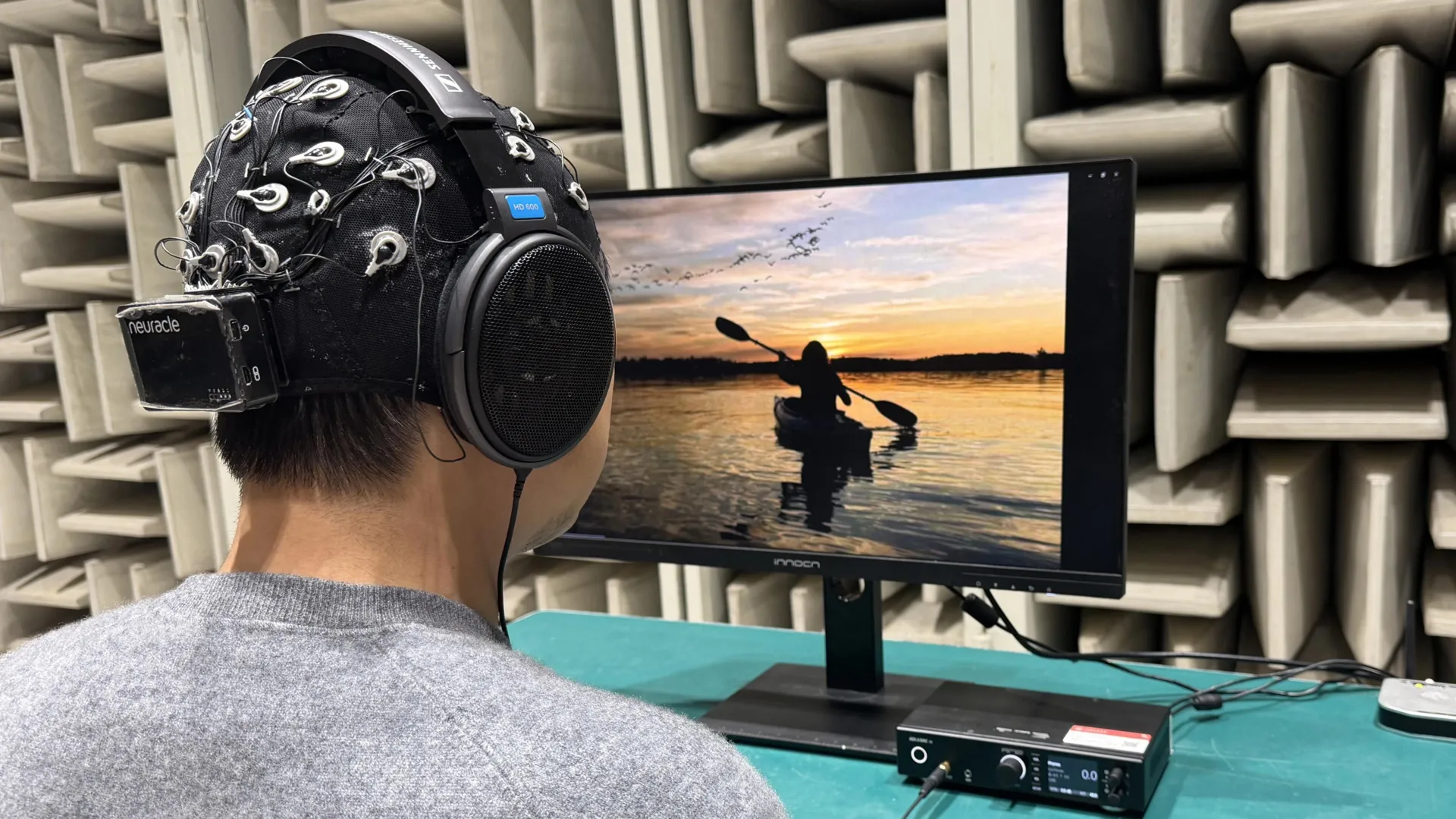
- EEG brain scans revealed that closing the eyes pushes the brain into a 'neural criticality' state that over-filters incoming information, suppressing not just background noise but the target sounds participants were trying to hear.
- In the headphone experiment, participants adjusted volume until test sounds were just barely audible over background noise, performing worst with eyes closed and best when visuals matched the audio.
- The researchers noted the effect is specific to noisy environments — in quieter conditions, closing the eyes may still help detect subtle sounds.
- The team plans follow-up tests using incongruent pairings, such as hearing a drum while seeing a bird, to determine whether the benefit comes from any visual input or requires perfect audio-visual matching.
Why it matters: For the billions of people navigating daily noisy environments — cafés, offices, transit — the instinct to close their eyes to focus on a faint sound may actually be working against them, according to EEG-backed evidence from Huang's team. The practical takeaway is concrete and immediate: keeping eyes open, especially with matching visual context, better anchors the auditory system to external sound. Future research on mismatched pairings could reshape how we think about attention versus multisensory integration.
Ask SkimNews