Silicon Solar Modules Triple Power-to-Weight to 23.6 W/kg — SkimNews
Get the Energy newsletter
Daily energy & climate — solar, EVs, oil, the policy fights and tech bets shaping the transition. Free.
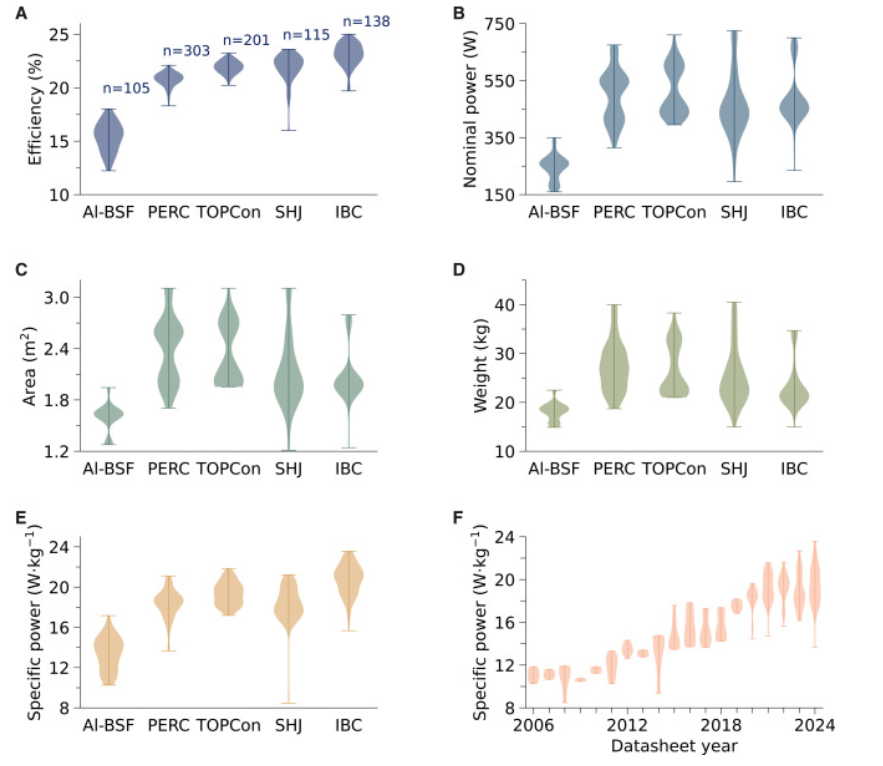
- International research team found that the specific power of commercial silicon solar modules rose from roughly 8.5 W/kg in the early 2000s to 23.6 W/kg today, a metric crucial for weight-sensitive uses like space and portable panels.
- Bruno Vicari Stefani, co-author, said the work provides a comprehensive body of evidence underscoring a shift from "one-size-fits-all" module designs toward application-specific configurations.
- Co-author Matthew Wright said silicon is "no longer seen as a bulky module, confined to a rooftop," pointing to high specific-power designs now used in aerospace.
- Bifacial gains increase the effective specific power of PERC, TOPCon, HJT, and IBC modules, narrowing gaps between top technologies; HJT modules responded best to combined temperature and rear-side illumination.
- Glass dominates module weight at 54%–86%, with bifacial modules generally heavier due to dual 2.0-mm glass layers versus the single 3.2-mm sheet on monofacial modules; aluminum frames make up 6%–19% and encapsulants 2%–15%.
- Larger or thicker-glass modules can reach 26–39 kg, and the researchers warned that thinning glass or lightening frames to boost specific power may compromise mechanical reliability.
- The findings were published in Cell Reports Physical Science under the title "Increasing specific power and the emergence of new markets for crystalline silicon photovoltaics," by scientists from UNSW, Newcastle Energy Centre, Brazil's UFSC, the US DOE's National Laboratory of the Rockies, and the University of Oxford.
Why it matters: For aerospace, portable, and mobile solar markets where every kilogram matters, the 8.5-to-23.6 W/kg jump makes silicon competitive in applications once dominated by thin-film or multi-junction cells. The catch, as the researchers themselves flag, is that glass accounts for 54%–86% of module weight — so further gains require either thinner or lighter glass, which they acknowledge could compromise mechanical reliability and rooftop handling.
Ask SkimNews