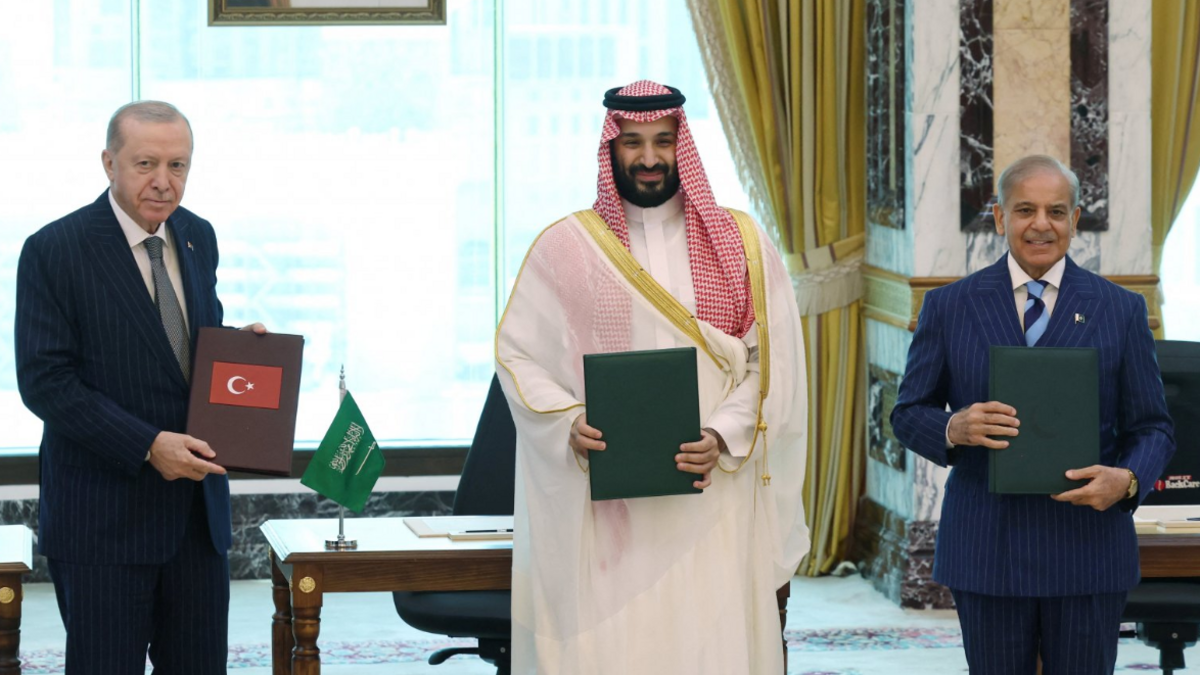
Pakistan, Saudi Arabia, Turkiye Sign Joint Defence Pact — SkimNews

Get the Geopolitics newsletter
Daily geopolitics — wars, elections, sanctions, the diplomatic moves that move markets. Free.
- The Mecca Joint Defence Pact was signed Friday by Turkiye, Saudi Arabia and Pakistan — building on a prior Riyadh-Islamabad agreement — using cautious language that an attack on one 'should be' treated as an attack on all, not 'necessarily,' per Killowen Group chairman Harlan Ullman.
- Each signatory brings a distinct capability to the pact: Pakistan's nuclear arsenal and battle-hardened military, Turkiye's NATO membership and drone technology, and Saudi Arabia's financial muscle, per Al Jazeera's Osamah Bin Javaid.
- Saudi Arabia has been attacked by Iran and Iranian-backed groups since the US-Israeli war against Iran began in late February; Pakistan has been in a border conflict with Afghanistan since February and exchanged fire with India in May 2025.
- President Donald Trump's 'fend for themselves' approach to allies has driven regional states toward alternatives, per Killowen Group chairman Harlan Ullman, who said 'it's clear to me that our allies are looking elsewhere.'
- Israeli Prime Minister Benjamin Netanyahu has begun warning of an emerging 'Sunni axis,' which analysts argue could become a self-fulfilling prophecy uniting Sunni-majority states.
- The Abraham Accords — the US-backed normalisation between Israel and the UAE — form a rival regional grouping, while potential expansion of the new pact to Egypt, Qatar, Syria or the UAE faces obstacles from domestic priorities in those countries.
Why it matters: The three signatories each face active military threats — Pakistan from Afghanistan and India, Saudi Arabia from Iran-aligned attacks since late February, and Turkiye from Kurdish militants and Israel tensions. Their deliberately vague 'should be' rather than 'necessarily will be' language means the pact currently operates as coordinated diplomatic positioning rather than a binding mutual defence obligation.
Ask SkimNews