Inflation fears on the rise as one-year outlook in Fed survey hits highest level since May 2023 — SkimNews

Get the Finance newsletter
Daily finance — markets, central banks, M&A, the prints that move money. Free.
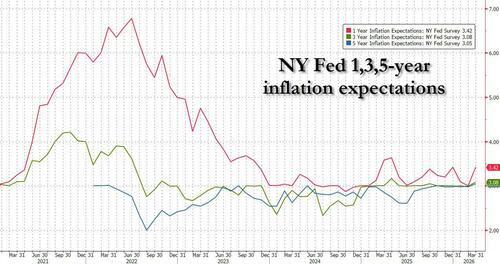
- New York Federal Reserve's Survey of Consumer Expectations found one-year inflation expectations rose to 3.9% in September, up 0.3 percentage points from August and the highest reading since May 2023, when it hit 4.1%.
- Household spending growth expectations climbed to 5.5%, also up 0.3 percentage points month over month and matching the May 2023 peak — suggesting consumers expect both higher prices and more spending simultaneously.
- Longer-term expectations were more anchored: the three-year view edged up 0.1 point to 3.3%, while the five-year outlook held steady at 3%.
- Fed funds futures are pricing in a rate of 5.58% in five years, well above the current target range of 3.75%-4%, implying markets expect a much more aggressive central bank ahead.
- Market-based inflation signals are flashing hotter than the survey — the five-year breakeven rate sits at 2.35%, the highest of the year, with Treasury yields hitting levels not seen since the early 2000s.
- New York Fed President John Williams has said policymakers can "take their time" evaluating rate decisions, and August inflation came in below expectations per the Fed's preferred gauge — conditions the FOMC is weighing as it prepares to hold rates at its October meeting.
- Fed officials consider consumer expectations a key driver of realized inflation, making the September jump in near-term outlook a data point the FOMC will be watching closely even as it pauses.
Why it matters: With one-year inflation expectations at 3.9% — nearly double the Fed's 2% target — and household spending growth expectations hitting a May 2023 high of 5.5%, the survey captures consumers bracing for a hotter-than-targeted price environment with demand still expanding. The Fed views expectations as a self-fulfilling driver of actual inflation, which is why the divergence between a near-term outlook of 3.9% and a five-year view still anchored at 3% is consequential: the front end of the curve is where expectations can unmoor, and market-based signals (5-year breakeven at 2.35%, yields at multi-decade highs) suggest professional investors see more persistence than households do.
Ask SkimNews