Brain develops from two distinct progenitor cell types — SkimNews

Get the Health newsletter
Daily health & science — research, biotech, public health, the studies worth knowing. Free.
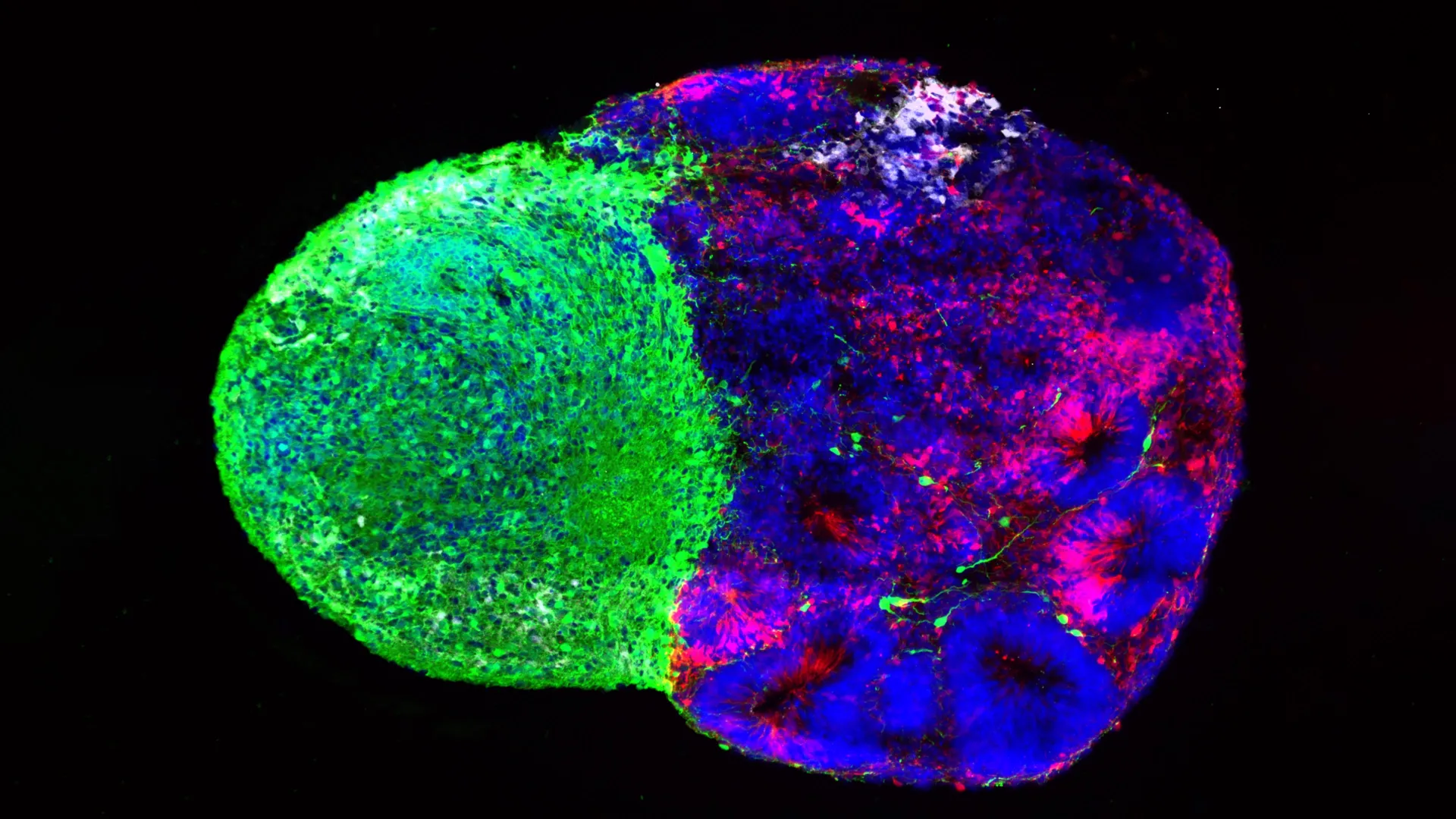
- Stanford's Kyle Loh and colleagues found that forebrain/midbrain neurons and hindbrain neurons develop from two separate progenitor cell types in embryos, overturning the assumption they share a common origin.
- Mouse embryo studies showed one progenitor type expresses the gene OTX2 and yields front-brain neurons, while another expressing GBX2 produces hindbrain neurons — a pattern confirmed in human cells.
- Loh's team grew functional human hindbrain motor neurons in a dish for the first time by starting with the correct GBX2-type progenitor cells, explaining why prior attempts using forebrain-destined progenitors had failed.
- The same two-origin architecture appears in chickens, zebrafish, and acorn worms, placing the dual-origin brain system at least 550 million years old; jellyfish, which diverged 600–700 million years ago, still have two separate nervous systems.
- Hindbrain neurons govern breathing, sleeping, eating, and heart rate, and their loss causes the speech and swallowing deficits in ALS and spinal muscular atrophy — both now directly researchable with lab-grown tissue, Loh says.
- GLP-1 drugs Ozempic and Wegovy suppress appetite in mice by acting on the hindbrain, and the new ability to grow those neurons should let scientists finally pin down the mechanism in humans, according to Loh.
- Loh argues the two-track development freed evolution to experiment with the forebrain — yielding memory and creativity — while the hindbrain handled survival basics.
Why it matters: Researchers can now grow the specific human neurons that ALS, spinal muscular atrophy, and GLP-1 appetite-suppression drugs act on, unlocking disease modeling and drug-mechanism studies that were blocked because no one could produce the right cells. The hindbrain controls breathing, heart rate, and swallowing — functions whose failure kills — making this a practical lab breakthrough with immediate disease-research applications.
Ask SkimNews