Ex-DOE Official: 'Deterrence Gap' Talk Hands Adversaries a Free Pass — SkimNews
Get the Geopolitics newsletter
Daily geopolitics — wars, elections, sanctions, the diplomatic moves that move markets. Free.
- The author, a roughly 30-year veteran of the Department of Energy who held senior roles in its intelligence office and the National Nuclear Security Administration, argues that U.S. officials' public anxiety about 'deterrence gaps' reveals infirmities to hostile observers rather than redressing them.
- Adm. Charles Richard, then commander of U.S. Strategic Command, wrote a public 2022 letter to Congress asserting a 'deterrence and assurance gap' exists, and in a 2025 essay with Franklin Miller and Robert Peters argued the lack of proportional non-strategic, non-ballistic theater-range systems could let Beijing, Moscow, or Pyongyang use tactical nukes for 'coercive purposes' or 'operational advantage.'
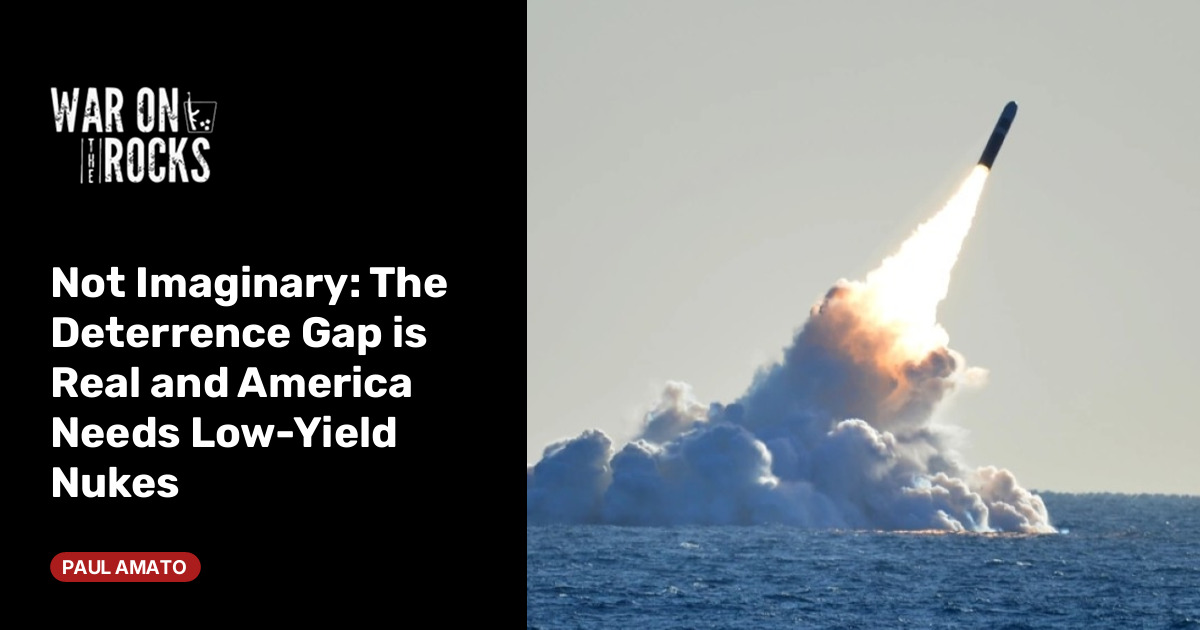
- The 2018 Nuclear Posture Review led to the 2020 fielding of W76-2 low-yield warheads on Navy ballistic missile submarines and a planned nuclear-armed sea-launched cruise missile that the Navy does not expect to field until 2034 — a gap the author warns invites adversaries to read as a window of opportunity.
- Political scientist Robert Jervis observed a peculiar American tendency to 'stress, and often exaggerate' its own weakness when advocating strategic systems, warning that 'the state will fail the test it has set for itself' by declaring security depends on remedying a self-defined problem.
- The Reliable Replacement Warhead episode illustrates the pattern: in 2007, the secretaries of State, Defense, and Energy warned of 'technical risks' to the aging stockpile and said without the program the U.S. could not 'sustain its strategy of deterrence' — Congress declined to fund it the next year, and many of the same officials smoothly pivoted to affirming the stockpile's reliability.
- The author counters that the constraint on responding to a non-strategic nuclear attack is normative, not operational: the U.S. already has conventional forces and nuclear weapons of various yields, but doctrine insists only theater-deployed, proportional low-yield systems can deter limited use.
Why it matters: The argument matters because U.S. officials keep publicly cataloging the very vulnerabilities they intend to fix — and the author, drawing on three decades inside the nuclear enterprise, warns that adversaries read those confessionals as signals about American decision-making. If the sea-launched cruise missile slips past its 2034 target while China eyes Taiwan on a shorter timeline, the rhetoric itself becomes a strategic liability, not just an embarrassment.
Ask SkimNews